Pump size selection is one of the most common points of confusion when booking concrete pumping for a commercial project. Many GCs and project managers know they need a pump but are less certain about what size is appropriate for their specific job, their pour volume, or the phase of construction they are in.
Getting this right matters. A pump that is too small creates output bottlenecks and delays. A pump that is overspecified for an early-phase pour may not fit the site or may be unnecessarily expensive. On a multi-phase commercial build, the right answer changes as the project progresses.
Pump Size vs. Project Phase: Quick Reference
The table below provides a fast reference for matching equipment to construction phase. For full specifications on each unit, see our equipment page.
| Project Phase | Typical Pour Type | Recommended Boom Range | Output Requirement |
|---|---|---|---|
| Foundation | Grade beams, pile caps, mat slabs | 28m to 30m | Moderate; precision over speed |
| Lower floors / podium | Floor slabs, walls, columns | 36m to 47m | Medium-high; consistent horizontal reach |
| Mid-rise floors | Floor slabs, shear walls | 47m to 56m | High; volume and reach balanced |
| High-rise upper floors | Large floor plate slabs | 63m to 65m | High; maximum vertical reach |
| Top-out / above boom reach | Upper slabs, core walls | Placing boom | High; structure-mounted, fed by ground pump |
| Complex simultaneous | Multiple pour areas at once | Multiple units | Very high; requires fleet depth and coordination |
The Fleet Range: From 20m Boom Pumps to Placing Booms
Concrete boom pumps are classified primarily by their reach in metres. A 28m pump extends approximately 28 metres from the truck. A 65m pump extends to 65 metres. Placing booms are a separate category: they mount on the structure itself, rotate to reach the pour area, and are fed by a ground pump running below.
Fleet depth matters because a pumping company with only mid-range trucks cannot handle a project that evolves from foundation work to high-rise upper floors. They will reach the limit of their equipment before you reach the top of your building. Premier’s fleet spans the full commercial range from 20m through 65m boom trucks and placing booms.
Foundations, Grade Beams, and Pads: 28m to 30m
The foundation phase requires precision more than reach. Grade beams, pile caps, mat slabs, and spread footings are poured at or near grade, and the challenge is accurate placement into tight or deep formwork. Smaller boom trucks are well suited to this phase. They maneuver more easily on sites still in early development stages and provide the control needed for careful pours into formed foundations.
Bringing a 65m boom onto a tight foundation site creates unnecessary complications without adding value. Right-sizing the pump to the phase keeps the job running efficiently.
Mid-Rise and Floor Slabs: 40m to 50m
As the structure rises and floor slab pours begin, reach requirements increase. Floor slabs on commercial buildings cover large horizontal areas, and the pump needs to reach across the full plate without constant repositioning. The 40m to 50m range handles this phase effectively.
Slab pours at mid-rise heights are also higher volume than foundation pours. A pump that is too small creates a bottleneck that backs up trucks and slows the pour. For more on this, see our article on how far a boom pump can reach and which size to choose.
Upper Floors and High-Rise Work: 65m Boom Pumps and Placing Booms
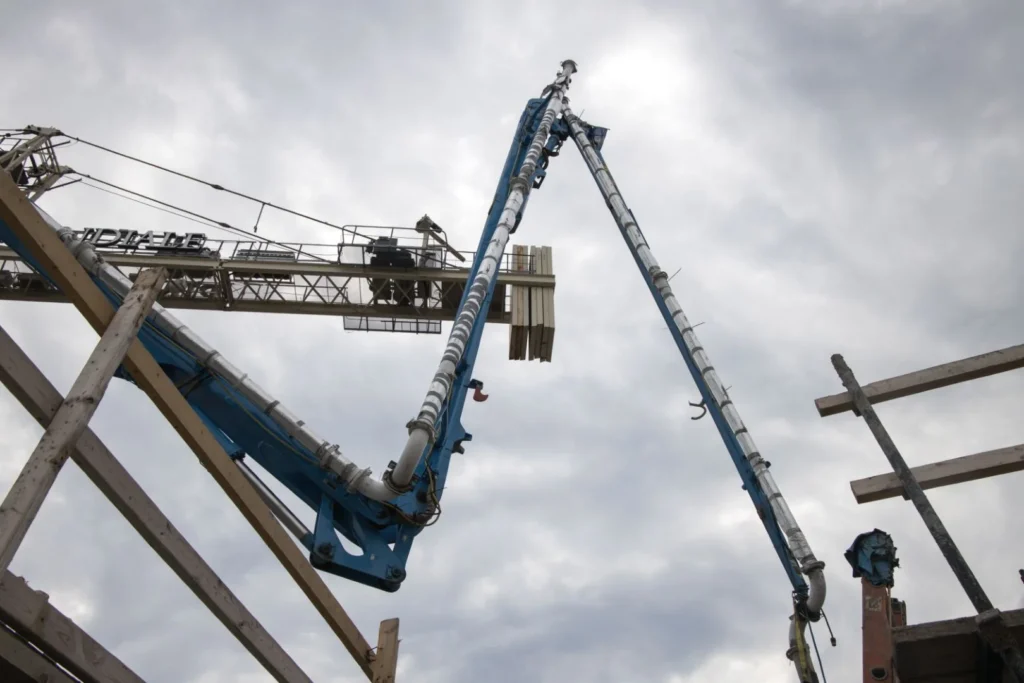
At significant heights, ground-based boom pumps reach their practical limit. Once the structure climbs past the reach of a 65m truck, or when horizontal reach across a large upper floor plate is the constraint, placing booms become necessary.
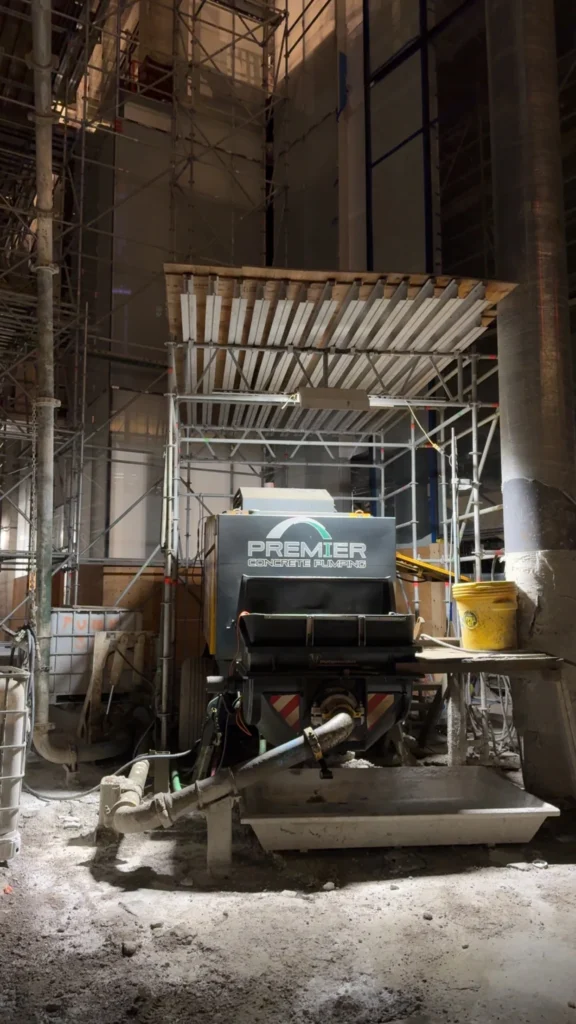
Placing booms are secured to the building structure and climb with the building as it rises. A ground pump feeds concrete up through a pipeline to the placing boom, which then distributes it across the pour area. On the largest projects, both a 65m boom and a placing boom may run simultaneously, covering different sections of the site. Premier ran exactly this configuration on the CIBC Square project in Toronto, coordinating multiple units across a complex site layout.
For a full breakdown of when placing booms are the right choice, see our article on when you need a placing boom for a high-rise project.
Multiple Pumps Running Simultaneously
Large commercial projects often require more than one pump operating at the same time. A mat slab pour may need two boom trucks to reach opposite ends of the plate. A high-rise in an active phase may have a placing boom handling upper floors while a 40m truck continues podium or foundation work below.
The ability to run multiple units simultaneously requires a deep fleet and a coordination team experienced enough to manage it. The concrete supply chain also needs to be planned accordingly: multiple pumps running at peak output absorb a significant number of trucks per hour, and the batch plant schedule needs to match.
The Conversation You Need to Have Before Booking
Pump size should not be guessed at. A good pumping contractor will ask the right questions and advise on appropriate equipment based on your specific project. Before your first pour, the conversation should cover:
- What are you pouring, and at what phase of the project?
- What height does the pump need to reach?
- What is the pour volume in cubic metres?
- How long is the pour expected to take?
- Are there site access constraints that affect pump positioning?
- Will multiple pumps be needed simultaneously or across phases?
If your pumping contractor cannot work through these questions with you before the job, that is a signal worth paying attention to. For a full list of pre-pour questions to ask, see our guide on questions to ask your concrete pumping contractor.
Talk to Premier About Your Project
Premier Pumping has operated across Southern Ontario since 1989. Our fleet covers the full commercial range from 28m boom trucks through 65m units and placing booms, and we have experience coordinating multi-pump, multi-phase pours on some of the GTA’s most demanding commercial and ICI projects.
Contact us to walk through your project and discuss the right equipment for each stage.
Pump size selection is one of the most common points of confusion when booking concrete pumping for a commercial project. Many GCs and project managers know they need a pump but are less certain about what size is appropriate for their specific job, their pour volume, or the phase of construction they are in. Getting this right matters—a pump that is too small creates output bottlenecks and delays, while an oversized pump may not fit the site or may be unnecessarily expensive.
Pump Size vs. Project Phase: Quick Reference
The table below provides a fast reference for matching equipment to construction phase. On multi-phase commercial builds, the right answer changes as the project progresses. For full specifications on each unit, see our equipment page.
| Project Phase | Typical Pour Type | Recommended Boom Range | Output Requirement |
|---|---|---|---|
| Foundation | Grade beams, pile caps, mat slabs | 28–30m | Moderate; precision over speed |
| Lower floors / podium | Floor slabs, walls, columns | 36–47m | Medium-high; consistent horizontal reach |
| Mid-rise floors | Floor slabs, shear walls | 47–56m | High; volume and reach balanced |
| High-rise upper floors | Large floor plate slabs | 63–65m | High; maximum vertical reach |
| Top-out / above boom reach | Upper slabs, core walls | Placing boom | High; structure-mounted, fed by ground pump |
| Complex simultaneous pours | Multiple pour areas at once | Multiple units | Very high; requires fleet depth and coordination |
Understanding the Fleet Range: From 28m to 65m Boom Pumps (and Placing Booms)
Concrete boom pumps are classified primarily by their reach in metres. A 28m pump extends approximately 28 metres horizontally from the truck. A 65m pump extends to 65 metres. Placing booms are a separate category: they mount directly on the structure itself, rotate to reach the pour area, and are fed by a ground pump running at a lower level.
Why Fleet Depth Matters
A pumping company with only mid-range trucks cannot handle a project that evolves from foundation work to high-rise upper floors. They will reach the practical limit of their equipment before you reach the top of your building. Premier’s fleet spans the full commercial range from 28m through 65m boom trucks and placing booms, allowing us to match the right equipment to each phase of your project.
This range matters because project needs change as the building rises. Bringing a 65m boom onto a tight foundation site creates unnecessary complications without adding value. Right-sizing the pump to the phase keeps the job running efficiently and keeps costs in check.
Foundations, Grade Beams, and Pads: 28–30m Pumps
The foundation phase requires precision more than reach. Grade beams, pile caps, mat slabs, and spread footings are poured at or near grade, and the challenge is accurate placement into tight or deep formwork. Smaller boom trucks are well suited to this phase.
Why Right-Size to Foundations
- Maneuverability: Smaller pumps navigate more easily on sites still in early development stages, before site roads and staging areas are fully established.
- Precision control: Foundation pours into restricted spaces benefit from the control and accuracy of a smaller boom.
- Cost efficiency: A 28–30m pump is more economical than a larger unit and adequate for the volume and reach required.
- Reduced site impact: Smaller equipment means less site disruption during early phases when other trades are still mobilizing.
For detailed guidance on preparing your foundation site, see our article on how to prep your site for concrete pumping.
Mid-Rise and Floor Slabs: 40–50m Pumps
As the structure rises and floor slab pours begin, reach requirements increase significantly. Floor slabs on commercial buildings cover large horizontal areas, and the pump needs to reach across the full plate without constant repositioning. The 40–50m range handles this phase effectively.
Volume and Output Considerations
Slab pours at mid-rise heights are also higher volume than foundation pours. A pump that is too small creates a bottleneck that backs up concrete trucks and slows the pour, adding cost and delay. A pump sized appropriately for your pour volume and the reach you need ensures consistent output and keeps the schedule on track.
Common Mid-Rise Mistake
Many GCs underestimate the volume required for a single day of slab pours. The result: a pump sized for a smaller project, backed-up trucks, and crews standing idle. Always communicate your expected cubic metres and pour timeline to your pump contractor. For more on this, see our article on how far a boom pump can reach and which size to choose.
Upper Floors and High-Rise Work: 65m Boom Pumps and Placing Booms
At significant heights, ground-based boom pumps reach their practical limit. Once the structure climbs past the reach of a 65m truck, or when horizontal reach across a large upper floor plate is the constraint, placing booms become necessary.
How Placing Booms Work
Placing booms are secured directly to the building structure and climb with the building as it rises. A ground pump feeds concrete up through a pipeline to the placing boom, which then distributes it across the pour area. On the largest projects, both a 65m boom and a placing boom may run simultaneously, covering different sections of the site.
Example: CIBC Square, Toronto
Premier ran exactly this multi-pump configuration on the CIBC Square project in downtown Toronto, coordinating multiple units across a complex site layout with tight space constraints and proximity to active streets. This is the kind of coordination required on the city’s most demanding commercial projects.
Understanding when to shift from boom pumps to placing booms is critical for large projects. Learn more in our detailed guide on pump setup for high-rise concrete projects.
Multiple Pumps Running Simultaneously
Large commercial projects often require more than one pump operating at the same time. A mat slab pour may need two boom trucks to reach opposite ends of the plate. A high-rise in an active phase may have a placing boom handling upper floors while a 40m truck continues podium or foundation work below.
Coordination and Fleet Requirements
The ability to run multiple units simultaneously requires a deep fleet and a coordination team experienced enough to manage it. You need:
- Equipment diversity: Different pump sizes available on call to respond to changing project needs.
- Experienced operators: Multiple skilled operators who can coordinate with each other and your concrete supply chain.
- Concrete supply planning: Multiple pumps running at peak output absorb a significant number of trucks per hour. The batch plant schedule needs to match pump capacity, not the other way around.
- Site logistics: Proper truck staging, spotting, and hose routing for safety and efficiency.
For guidance on safe hose routing and site logistics on complex jobs, see our article on safe hose routing for concrete pumps.
The Conversation You Need to Have Before Booking
Pump size should not be guessed at. A good pumping contractor will ask the right questions and advise on appropriate equipment based on your specific project. Before your first pour, the conversation should cover:
- What are you pouring, and at what phase of the project?
- What height does the pump need to reach?
- What is the pour volume in cubic metres?
- How long is the pour expected to take?
- Are there site access constraints that affect pump positioning?
- Will multiple pumps be needed simultaneously or across phases?
- What is the concrete mix design, and are there any special requirements?
- Are there nearby power lines, railways, or other hazards?
Red Flag
If your pumping contractor cannot work through these questions with you before the job, that is a signal worth paying attention to. Vague conversations lead to wrong equipment and project delays. For a full list of pre-pour questions to ask, see our guide on what to expect on the day of a concrete pump pour.
Boom Pumps vs. Line Pumps for Commercial Work
While boom pumps dominate commercial and high-rise work, line pumps still play a role in certain commercial scenarios. Understanding the distinction helps you make the right choice for your project:
Boom Pumps: When to Use
Best for: Large floor slabs, high-rise work, projects requiring reach and volume. Boom pumps offer the flexibility to reach across large floor plates without constant repositioning, and they deliver higher output per hour.
Line Pumps: When to Use
Best for: Interior work, basement pours, machine bases, tight spaces where a boom pump cannot fit or maneuver. Line pumps are fed through hose lines and offer precision for restricted access areas.
For more detail on this comparison, see our full guide: boom pump vs. line pump.
Frequently Asked Questions
Q: How do I know if a single pump will be enough for my commercial pour?
Work with your pump contractor to estimate cubic metres and pour duration. If the pump’s hourly output (cubic metres per hour) covers your total volume in the timeframe you have, one pump is sufficient. If not, you need a larger pump or a second unit. Your pump contractor should run these numbers with you before booking.
Q: Can I switch pump sizes mid-project?
Yes, and it’s common on multi-phase commercial builds. You might use a 28–30m pump for foundations, then move to a 40–50m pump for floor slabs, and finally to a 65m boom or placing boom for upper floors. Communicate your multi-phase plan upfront so the pump contractor can plan equipment availability.
Q: What happens if weather delays my pour?
Weather delays are common in Ontario. Good communication with your pump contractor is essential. Discuss rescheduling options, standby fees, and contingency plans before the scheduled date. For guidance on pumping in challenging weather, see our article on whether you can pour concrete in the rain.
Q: Is there a minimum or maximum pour volume for commercial pumping?
No hard minimums or maximums, but economics matter. Very small pours may not justify the mobilization cost of a pump. Very large pours require planning, multiple units, and careful coordination with concrete supply. Discuss your volume with your contractor to ensure economics make sense for both parties.
Q: How does concrete mix design affect pump selection?
Standard mixes, self-consolidating concrete (SCC), and low water-cement mixes all pump differently. Some mixes are easier on equipment, others are more demanding. Early communication with your concrete supplier and pump contractor ensures the mix design works with the pump you’ve selected. For more, see our article on choosing concrete mix and pump line size.
Q: What should I budget for concrete pump rental on a commercial project?
Costs vary based on pump size, region, availability, and project complexity. A 28–30m pump is less expensive than a 65m or placing boom. Setup fees, standby charges, and operator costs also factor in. Contact your pump contractor for a quote based on your specific project.