Underground parking garages are some of the most planning-heavy pours we take on. There is no such thing as a routine underground garage pour. Every site has its own structure, access points, and sequencing, and the setup has to be worked out before a single truck rolls. Here is how that process actually works, and what goes into pumping concrete safely and efficiently below grade on an Ontario job site.
It Starts With a Site Visit, Not a Quote
Underground parking garages are usually built before the structure above goes up, and the layout is rarely simple enough to plan from drawings alone. Because of that, every underground garage job starts with a site visit. We need to see the actual setup: how the site is accessed, where the pump can be positioned, whether we are working around an existing structure, and how far concrete needs to travel to reach the pour area.
That site visit determines almost everything that follows, including whether the job calls for one of our larger boom pumps, a straight line pump run, or some combination of both.
Boom Pump or Line Pump: How the Decision Gets Made
There are two basic ways to get concrete into an underground garage, and the choice comes down to access and distance, not preference.
If the pour area is close enough to reach with a manageable hose run, a line pump is usually the better tool. Running several hundred feet of line just to reach a parking structure, and then more to get around inside it, adds setup time and risk without adding any benefit. As long as the pump can park close enough, line pump setups keep the job simpler.
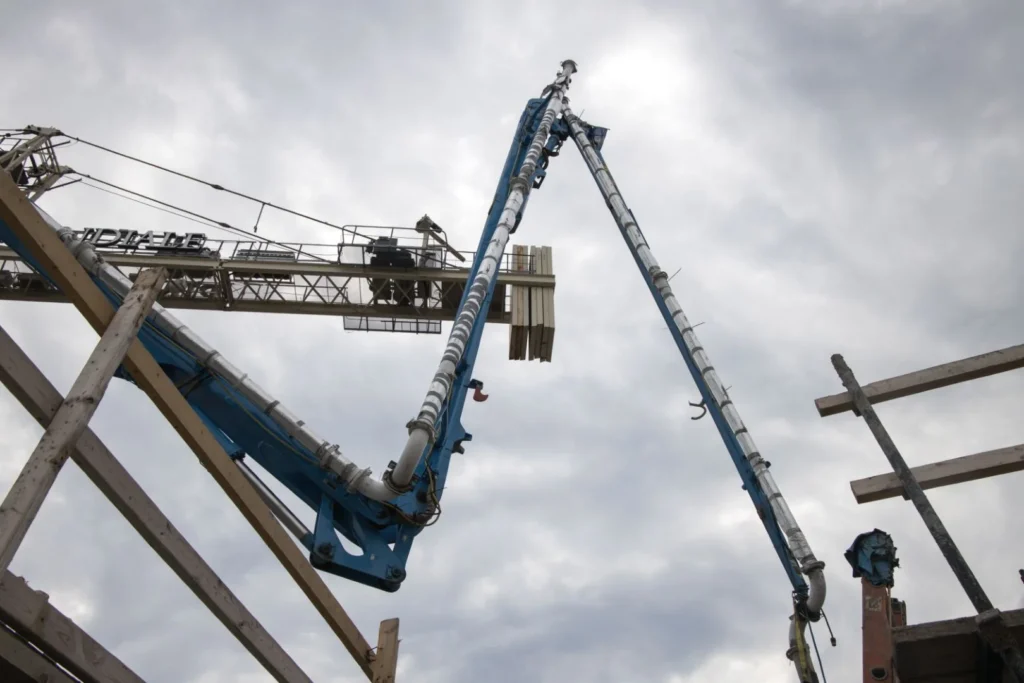
When that is not possible, we bring in a boom pump, often one of our larger units, and boom down into the structure before running line the rest of the way in. That approach is common when the garage sits well below grade and there is no practical way to stage a line pump close enough to the work.
On larger sites, we will sometimes run both at once, positioning a bigger boom pump to reach down and into the structure and then feeding line off that pump to get concrete into tighter areas the boom cannot reach directly. Which setup applies is a site-by-site call, and it is one of the main reasons the pre-pour site visit matters as much as it does.
| Factor | Line Pump | Boom Pump |
|---|---|---|
| Best used when | Pump can park close to the pour area on the same level | Garage sits well below grade or the pump cannot get close enough on foot |
| How concrete travels | Runs entirely through hose from the pump to the pour area | Boom reaches down into the structure, then line carries concrete the rest of the way in |
| Typical setup time | Faster when access is close and straightforward | Longer, more involved setup to position and stage the boom safely |
| Common applications | Slab-on-grade areas, shotcrete, tighter interior access | Ramps, upper levels, and any pour area out of practical line pump range |
| Combined use | Often feeds off a boom pump on larger or deeper sites | Positioned to reach down and in, with line run off it for tighter areas |
Why Underground Garage Pours Take Longer
Because there is already structure in place around an underground garage, hose and boom routing has to work around columns, forming, and whatever else is on site, rather than across open ground. Getting into the nooks and crannies of a below-grade structure takes more setup than a straightforward slab pour, which is why underground parking garage pours tend to run as long, extended days rather than quick in-and-out jobs.
Shotcrete Applications
Some underground garage work calls for shotcrete rather than a standard pour, particularly on retaining walls or areas where formed concrete is not practical. Shotcrete jobs run off a line pump rather than a boom, and they require even more upfront planning: figuring out exactly where the line needs to go, how to get it into a tight area, and what angle gives the operator the best control over placement. There is more setup involved than a typical line pump run, but the equipment itself does not change.
Moving Up Through the Structure
Once a level is complete and the pour moves up toward grade, often through a ramp section, the work shifts to a boom pump. From that point, positioning depends on how high the boom needs to reach, whether the crew is working one section of the ramp at a time or pouring the full run, and how close the pump can get. Larger boom pumps are typically brought in for this stage of the job.
Air Quality Is Not a Site Concern
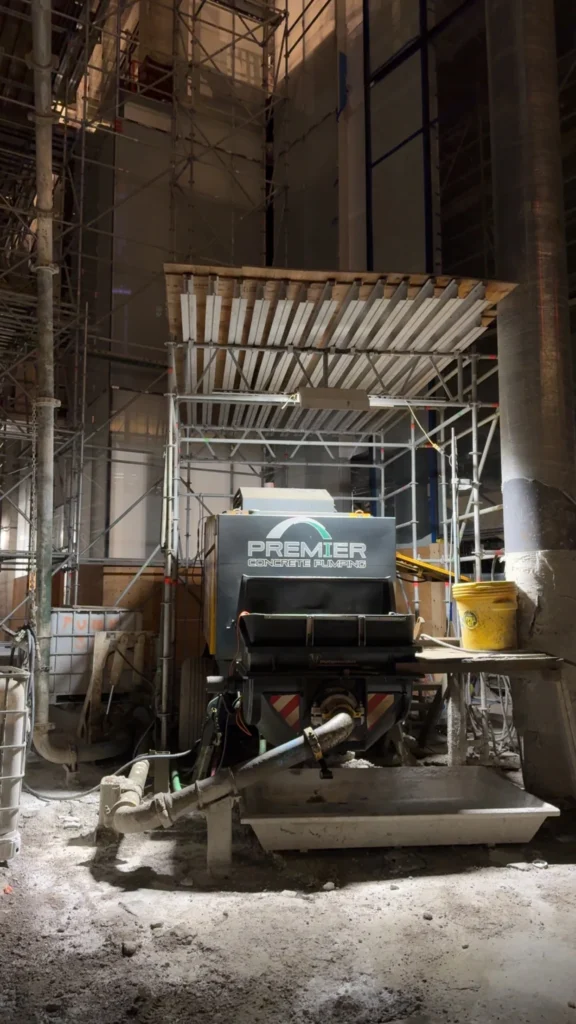
A common question we get is whether exhaust fumes or air quality become an issue when equipment is operating below grade. They do not, because the pump itself always stays outside in an open, ventilated area. Only the line goes into the structure. We are not running equipment inside an enclosed space, so this is not something that factors into how we plan an underground garage pour.
Concrete Mix Requirements
Underground parking garage slabs carry constant vehicle traffic, so the mix used is typically a higher MPa than a standard slab pour. The concrete needs to be substantial and thick enough to hold up under that load, and a higher strength mix also helps it cure and dry faster, which matters on a job where the structure is being built in stages above and below at the same time.
A Busy, Multi-Crew Site
Underground garage pours rarely happen in isolation. It is common to have crews finishing a slab on the level above while a pour is underway below, which means multiple crews and a lot of people working in the same footprint at once. On these jobs, we put more than one person on site and run radios throughout the pour to keep communication open between the operator at ground level and the crew working below grade. If the pump needs to stop abruptly for any reason, that communication line has to be reliable, and it is one of the non-negotiables on this type of job.
Safety Considerations Specific to Underground Work
Beyond our standard pump operating safety procedures, underground garage work sometimes brings confined space considerations into play, depending on how tight the area is that the hose needs to reach. How much of a factor that becomes depends entirely on the specific site and layout, which is another reason the initial site visit and planning stage matters before any equipment gets scheduled.
Every Underground Garage Job Is Planned Around the Site
There is no single formula for pumping an underground parking garage. Whether we use a line pump, a boom, or both together comes down to how the site is laid out, how the pour is sequenced, and how far concrete needs to travel to reach the work. That is true whether the structure sits below a residential mid-rise or a large commercial development.
If you have an underground parking garage pour coming up, the best next step is a site visit so we can walk the layout with you and put together the right equipment plan before scheduling. Contact Premier Concrete Pumping to set one up.