Booking a concrete pump for a commercial project is not the same as booking one for a residential pour. The stakes are higher, the compliance requirements are stricter, and the cost of choosing the wrong contractor shows up fast, whether as a failed safety inspection, an equipment breakdown mid-pour, or a crew that cannot meet the site’s documentation requirements.
The questions below give you a framework for evaluating a pumping contractor before you commit. A qualified commercial pumping company will have clear answers to all of them.
Quick Reference: What to Ask and What Good Answers Look Like
| Question | What a Qualified Contractor Will Say | Red Flag |
|---|---|---|
| Are operators certified and continuously trained? | Yes, with in-house tracking and renewal alerts | “They have their tickets” with no system behind it |
| Do you carry WSIB? | Yes, clearance certificate available on request | Hesitation or inability to produce documentation |
| Is your crew unionized? | Yes, all operators work to union standards | Unclear answer or non-union on a union-required project |
| What safety documentation can you provide? | Full package ready before mobilization | Scrambling to pull it together the morning of |
| What pump sizes do you run? | Full range from 28m through 65m plus placing booms | Limited to one or two boom sizes |
| Do you have backup pump capacity? | Yes, standby units available and pre-planned for large pours | “We haven’t had a breakdown in years” |
| How far in advance do you need to be booked? | Minimum one month for commercial; more for tendered work | Can do it next week without any caveats |
1. Are Your Operators Certified, and How Is Training Tracked?
On commercial sites, operator certification is not optional. Safety personnel will check credentials, and a crew member who cannot produce documentation may be removed from the site before a single metre of concrete is poured.
Ask the contractor how they track operator certifications. Do they maintain records in-house? Do they flag upcoming renewals before they expire? What happens if the assigned operator is substituted at the last minute? A contractor with a proper in-house tracking system can pull documentation on any operator on any job, immediately, regardless of who shows up that morning. You can learn more about how Premier handles safety and training on our health and safety page.
2. Do You Carry WSIB Coverage?
WSIB coverage is a baseline requirement on virtually every commercial site in Ontario. Ask for a clearance certificate and check the expiry date to confirm it covers the duration of your project. If a pumping contractor does not have it, they should not be on a commercial job site.
3. Is Your Crew Unionized?
Union status matters on institutional, government, and many large commercial projects. Beyond the contractual requirement, union certification means operators are working to a regulated standard of conduct, training, and compensation. Premier Pumping is a fully unionized company. All operators work to union standards on every job.
4. What Safety Documentation Can You Provide Before We Start?
Commercial sites often require a package of documentation before a pumping crew sets foot on site. This typically includes WSIB clearance, operator certifications, equipment inspection records, and confirmation of any site-specific safety training. A contractor that scrambles to pull this together the morning of the pour is not the right choice for a commercial project.
5. What Pump Sizes Do You Have in Your Fleet?
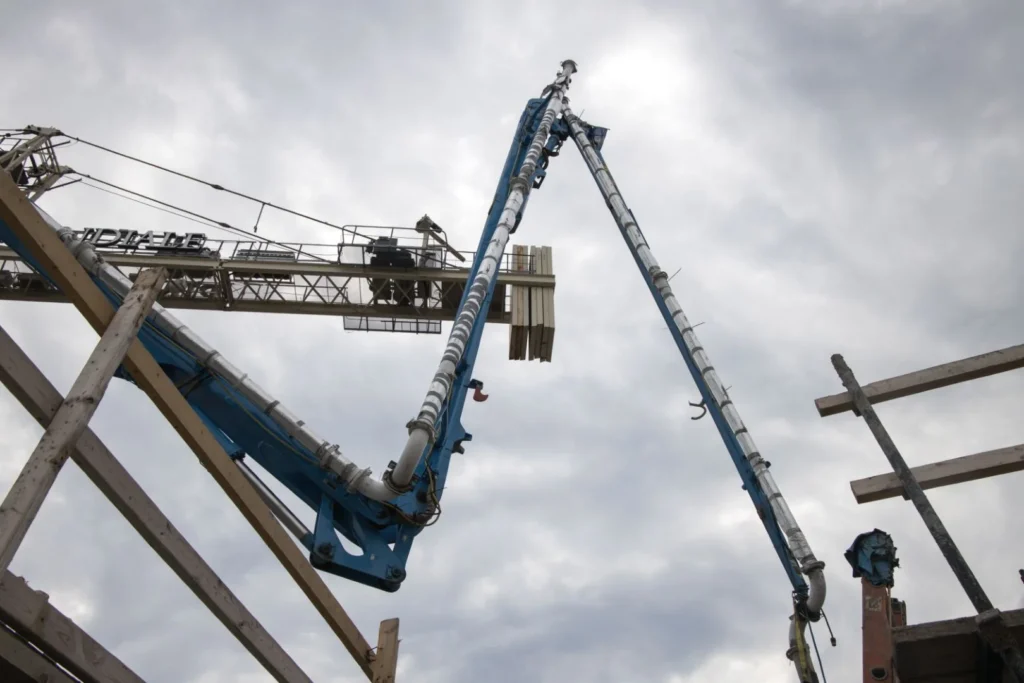
Fleet range matters more than most GCs realize. A contractor with only 28m to 40m boom trucks can handle residential and light commercial work, but they will not be able to support a high-rise project as it moves into upper floors. Ask specifically about the full range of boom sizes available, whether the company has placing boom capability, and whether they can run multiple units simultaneously.
For a full breakdown of what equipment is needed at each phase, see our article on how to choose the right concrete pump size for a commercial project. You can also review the complete fleet on our equipment page.
6. Can You Handle Multi-Phase and Continuous Pours?
Large commercial projects often involve pours across multiple phases, sometimes with different pump sizes at different stages. Some pours need to run continuously for 12 hours or more without stopping. Ask whether the contractor has experience coordinating multi-phase pours, whether they can stage backup equipment for continuous pours, and how they manage crew rotation when a pour extends beyond standard hours.
7. Do You Have Backup Pump Capacity?
If the primary pump goes down mid-pour on a commercial site, what happens next? A pumping company with no backup capacity leaves you with no options. For large or continuous pours, backup capacity should be part of the plan from the start. See our article on emergency concrete pumping for a detailed breakdown of what happens when equipment fails and how to protect your project before it does.
8. How Far in Advance Do You Need to Be Booked?
Commercial pours require coordination that takes time. Account setup, credit checks, site meetings, pricing agreements, safety documentation exchange, and equipment scheduling all need to happen before the pump rolls. For most commercial jobs, a minimum of one month of lead time is realistic. For more detail on the full booking process, see our guide on when to book a concrete pump.
9. How Is Pricing Structured for a Project Like Mine?
Commercial pumping pricing is typically volume-based and negotiated in advance. For large or long-term projects, preferred pricing is often available. Ask how pricing is calculated, what drives the rate (volume, mobilization, pump size, time on site), and whether a project-specific price list can be agreed upon before work starts.
10. Who Is the Point of Contact During the Pour?
On a large commercial pour, there needs to be a single point of contact at the pumping company who is reachable throughout the pour, knows the job details, and can make decisions if something changes. Ask who that person is and how to reach them before pour day.
Getting the Right Contractor on Your Project
Premier Pumping has operated across Southern Ontario since 1989. We carry full WSIB coverage, run a unionized crew, and maintain a fleet that spans 28m boom trucks through 65m units and placing booms. If you have a commercial project coming up, contact us to discuss your requirements before you finalize your pumping subcontractor.