Pump Setup for High-Rise and Multi-Storey Concrete Projects
When it comes to pumping concrete in high-rise or multi-storey projects, the challenge isn’t just getting concrete to higher floors — it’s doing it efficiently, safely, and with limited space.
At Premier Concrete Pumping, we’ve handled some of Ontario’s most complex vertical pours, from downtown Toronto towers to large-scale hospital and commercial developments. In this article, we’ll explain how high-rise concrete pumping works, what equipment we use, and how we adapt to the unique challenges of tight urban job sites.
Understanding High-Rise Pumping Challenges
Contrary to what most people think, pumping concrete upward isn’t the hard part — our powerful 65m boom pumps and placing booms are built to handle that. The real challenge is finding space to set up the pump safely.
Every tall building project comes with two main considerations:
Vertical reach – how high we need to pump the concrete.
Footprint – how much ground space we have to position the pump and deploy its outriggers safely.
In dense downtown sites, the second factor often dictates the equipment choice.
“Getting up and going in is easy — it’s parking the boom that’s the hardest part.”
— Sarah, Premier Concrete Pumping
How We Handle Tight Downtown Sites
We perform many downtown Toronto projects where space is at a premium. Streets are narrow, access is limited, and construction zones overlap with active traffic.
In these situations, we often start with smaller pumps — like a 47m or 52m boom — until enough ground is cleared to accommodate our 65m boom pump.
The smaller pumps allow us to keep projects moving without interrupting other site operations or closing multiple streets. Once the site footprint expands, we bring in the larger units to maximize reach and productivity.
This flexible, staged approach is one of the reasons Premier is trusted for high-rise construction throughout Southern Ontario.
Typical Setup for Multi-Storey Projects
Once the footprint is secured, setting up for a multi-storey pour involves:
Site Inspection: Assess available space, ground stability, and the reach required.
Boom Placement: The boom pump is positioned so the arm can extend up and in, minimizing hose extensions.
Footprint Coordination: Outriggers are fully deployed on stable ground, often requiring coordination with other trades and cranes.
Line Extensions (if needed): For sites where the boom can’t reach every area, we attach additional line hose off the boom tip to access deep or enclosed pours.
Continuous Flow Management: Operators monitor pressure, elevation, and hose alignment to ensure a consistent pour rate at height.
Using the 65m Boom Pump for Vertical Reach
Our 65 Meter RZ – 5 Section boom pump is the workhorse for high-rise applications. With a vertical reach of over 210 feet (64m) and horizontal reach of 195 feet, it can deliver concrete to the 5th–9th floors and beyond with ease.
| Pump Model | Vertical Reach | Horizontal Reach | Best Use |
|---|---|---|---|
| 47m RZ | 154’ | 135’ | Initial setup, tight access pours |
| 52m Multi-Z | 170’ | 150’ | Mid-rise pours or when space is limited |
| 65m RZ | 210’ | 195’ | Large-scale high-rise or open downtown sites |
We use our smaller booms during early construction phases or when the site footprint doesn’t yet allow space for the 65m’s outriggers. Once concrete slabs or road clearances expand, the 65m takes over — drastically improving speed and reducing setup changes.
Learn more about our fleet’s specs in How Far Can a Boom Pump Reach (And Which Size Should You Rent?).
What About Even Taller Buildings?
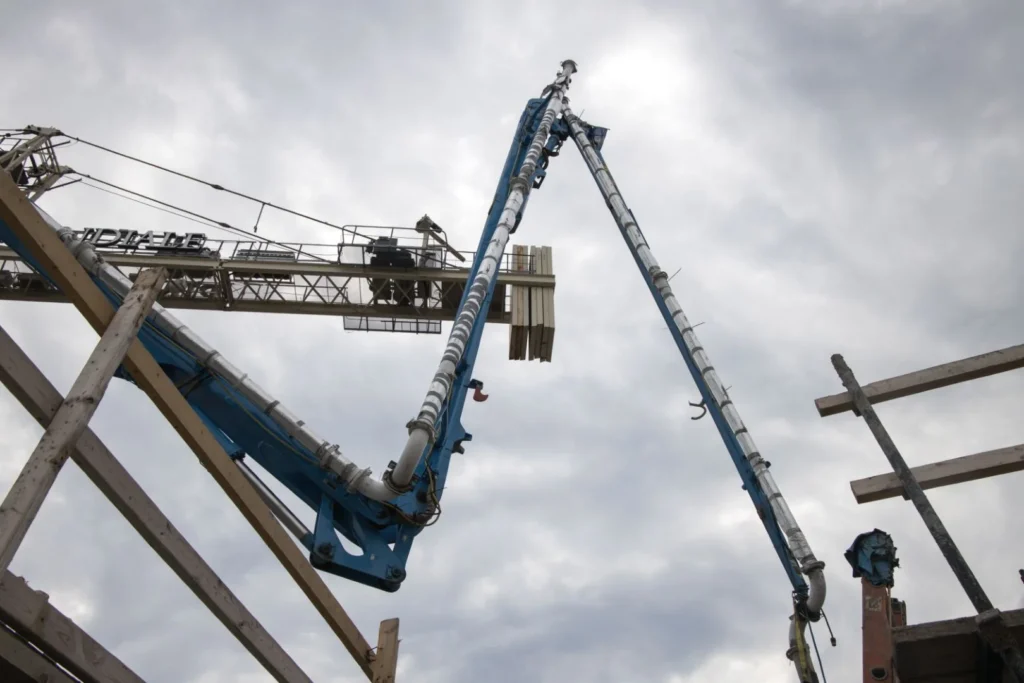
For towers that extend beyond boom reach — such as skyscrapers or major hospitals — we transition to placing boom systems.
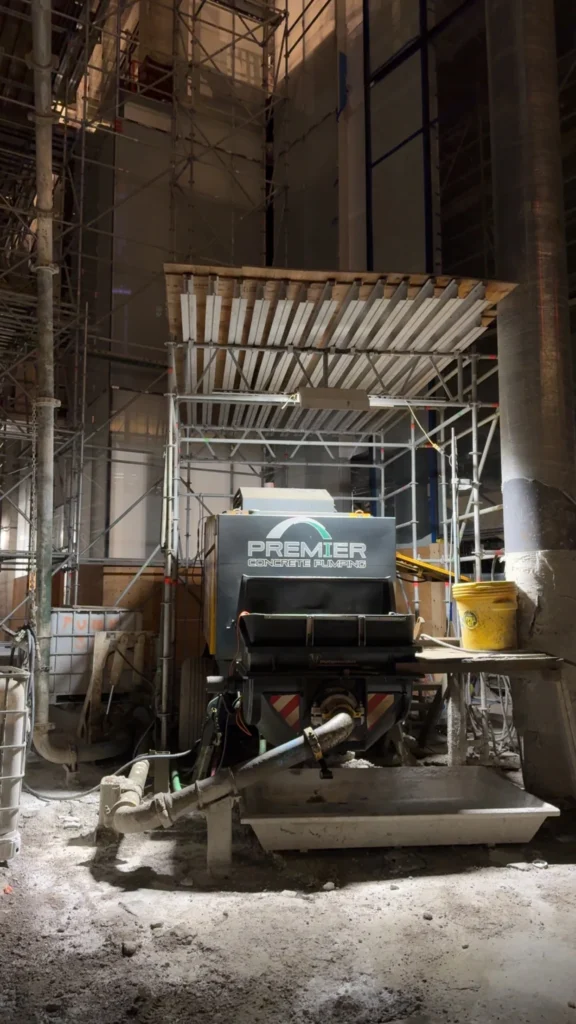
A placing boom is a freestanding or tower-mounted arm controlled by remote. It’s fed by a stationary or trailer pump at ground level, which pushes concrete vertically through steel delivery lines.
This method allows us to:
Pump concrete up dozens of storeys safely.
Minimize crane dependency.
Maintain a steady pour rate for columns, slabs, and walls.
Our Infrastructure Concrete Pumping division frequently uses these setups for projects like the Niagara Hospital and CIBC Square.
The Role of Site Coordination
High-rise pumping requires more than the right equipment — it demands coordination. Our operators work closely with site supervisors, crane operators, and finishers to:
Plan truck access routes and timing.
Communicate hose positioning on upper floors.
Synchronize pump output with concrete delivery schedules.
This teamwork ensures uninterrupted flow and prevents delays caused by overfilling or mix segregation at height.
For more on pre-pour coordination, read our article on How to Prep Your Work Site for Concrete Pumping.
Safety Considerations
Every high-rise pour introduces additional risks due to height, pressure, and restricted access. That’s why safety is a cornerstone of every Premier setup:
Stabilization: Outriggers are placed on compacted, stable ground.
Communication: Operators use radios or hand signals for upper-floor coordination.
Pressure Monitoring: Continuous checks ensure safe pumping through vertical lines.
Backup Planning: Every setup includes contingency procedures in case of stoppages or pressure loss.
We cover all of these protocols in detail on our Health & Safety page.
Frequently Asked Questions
1. How high can your boom pumps reach?
Our 65m boom can reach over 210 feet vertically, ideal for 5–9 storey buildings.
2. What if the site is too small for the 65m pump?
We use smaller booms (like 47m or 52m) until more ground space is available.
3. What’s the hardest part of high-rise pumping?
It’s not going up — it’s finding a stable place to park and set up the boom in dense city environments.
4. Do you use placing booms for taller buildings?
Yes. Once the height exceeds what a truck-mounted boom can reach, we install placing booms fed by a stationary pump.
5. How do you manage pressure when pumping to upper floors?
We adjust the pumping rate and monitor system pressure continuously to ensure steady, safe flow.
Related Articles
Final Thoughts
High-rise concrete pumping requires planning, precision, and experience. At Premier Concrete Pumping, we’ve perfected the process — from choosing the right boom size to managing tight urban footprints and coordinating multi-level pours.
Whether you’re building a mid-rise in Markham or a downtown Toronto tower, our experienced operators, advanced fleet, and adaptable setup strategies ensure that your project stays on schedule and your pour stays seamless.
Ready to plan your next multi-storey project? Contact our team today for expert guidance on equipment and setup.