
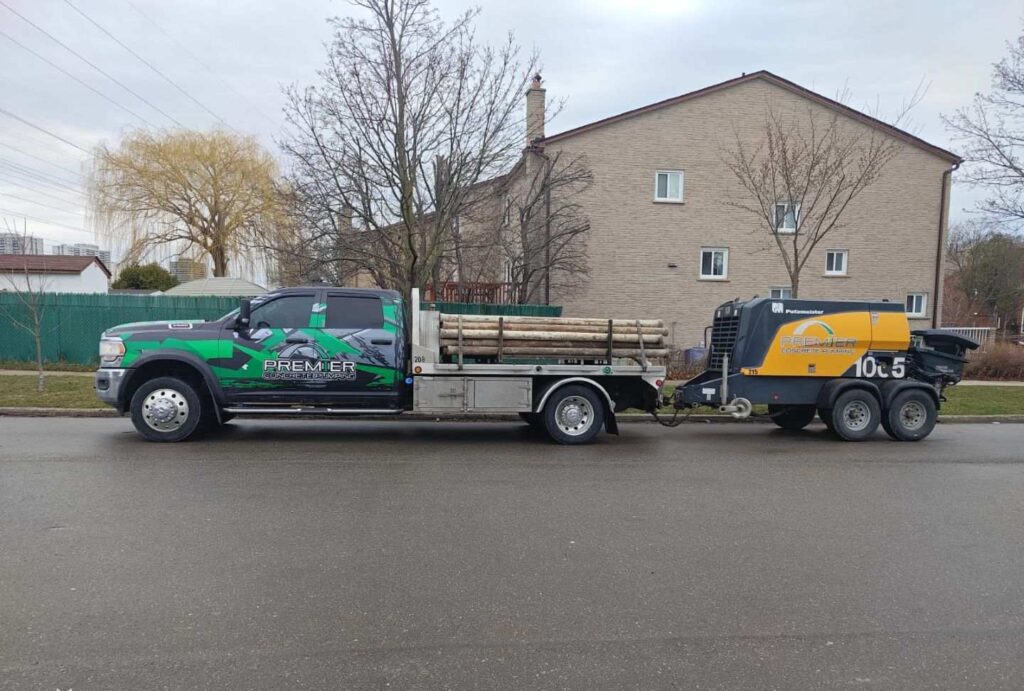

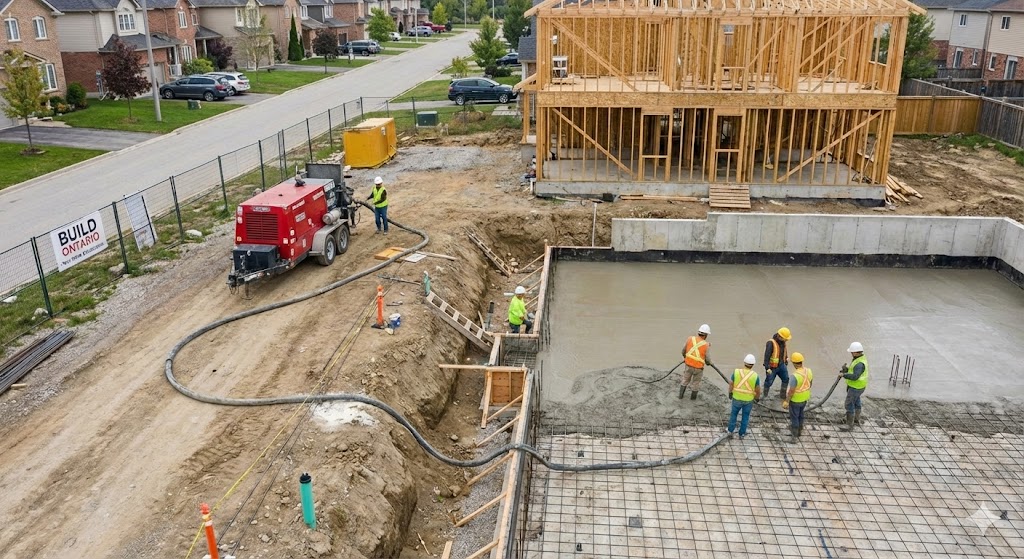
BSA 1005 Tow Behind Trailer Pump
- ACPA certified operator included
- WSIB clearance available
- Ontario owned since 1989
No boom, and that is the point. A tow behind trailer pump goes where a boom truck physically cannot: down a ramp into a basement, inside a finished structure, along a laneway, out across ground that will not carry 25 tonnes of truck. The concrete gets there through line rather than over the top, at up to 52 m³/h and 70 bar of delivery pressure, in whatever line size the job needs.
Other sizes in the fleet
A trailer pump is the simplest machine in the fleet and the one that solves the hardest access problems. There is no boom. The pump sits on a tow behind trailer, gets positioned wherever the ready-mix can reach it, and pushes concrete through delivery line to wherever the pour actually is.
The BSA 1005 places up to 52 m³/h on the diesel unit at up to 70 bar of delivery pressure, through a 180 mm delivery cylinder with a metre long stroke. Premier runs it with 2″, 3″ and 4″ line, spray nozzles and controlled pressure output, which between them cover everything from grout to large aggregate concrete. Line size is not a detail on this unit: it sets your maximum aggregate, your friction losses and, in practice, how far you can actually push the mix.
Setup is mechanical and quick, on three outriggers, and the trailer weighs 2,900 kg, so it can be positioned on ground that would not take a boom truck. What it costs you is labour and volume. Line has to be laid, supported, and washed out afterwards, and 52 m³/h is well short of what a boom pump places. On the jobs it suits, no other machine can do the work at all. Every booking includes an ACPA certified operator.
Typical applications: basement slabs and footings inside standing structures, interior and retrofit pours, restoration work, grout and shotcrete, remote or soft-ground sites, and long horizontal runs from the nearest delivery point.
Figures below are taken from the Putzmeister manufacturer data sheet for the BSA 1005 D5 and BSA 1005 E. Premier runs both diesel and electric configurations across the trailer pump fleet, so both columns are given where they differ.
⚙️ Output and Pressure
| Output, BSA 1005 D5 diesel | 52 m³/h |
| Output, BSA 1005 E electric | 47 m³/h |
| Delivery pressure | Up to 70 bar (1,015 psi) |
| Strokes per minute, diesel | 33 |
| Strokes per minute, electric | 31 |
| Line connection | SK 125 |
🔧 Pump and Cylinders
| Delivery cylinder diameter | 180 mm |
| Delivery cylinder stroke | 1,000 mm |
| Transfer tube | S 1812 |
| Hopper | RS 488, with agitator |
| Hopper capacity | Approx. 300 L |
| Filling height | 1.23 m |
🔋 Drive and Control
| Diesel drive, 1005 D5 | Deutz 55.4 kW, Stage 5 |
| Electric drive, 1005 E | 45 kW, iE03 |
| Control system | Ergonic 3 PS, graphic display |
| Remote | Cable remote control, 10 m |
| Flushing water pump | 50 L/min at 20 bar |
| Diesel tank | 120 L, diesel unit only |
🚛 Trailer and Weights
| Chassis | F8 tow behind |
| Outriggers | 3 x mechanical |
| Weight, diesel | 2,900 kg |
| Weight, electric | 3,000 kg |
| Coupler | DIN eye, with support wheel |
| Agitator safety | Automatic switch off, 60 mm grill |
All data are maximum theoretical values, and dimensions and weights depend on the equipment fitted. Maximum pumping distance through line depends on the mix, the line size, the number of bends and the vertical rise, so confirm it for your specific job rather than working from a headline figure. Need the full manufacturer document for a submittal package? Download the Putzmeister spec sheet PDF.
- WSIB clearance certificate. Available on request for ICI and institutional prequalification packages.
- Daily equipment inspection. Completed before the unit leaves the yard, documented, and available if your safety officer asks.
- Lines, hoses and clamps for the configuration agreed at booking, including 2″, 3″, 4″ and 5″ line options.
- ACPA certified operator. Every Premier operator is trained and certified to American Concrete Pumping Association standards. The unit does not go out without one.
- Line sizing advice before you book. On a line pump job the line size, route and mix have to work together. Tell us the mix design and the distance and we will tell you what line the job needs.
- Spray nozzles and controlled pressure output where the placement calls for them, including grout and shotcrete work.
- Pre-pour site walkthrough on commercial and institutional jobs. On line pump work this is where the line route gets agreed, which is the single thing most likely to cost you the morning if it is left to pour day.
- Unionized labour standards and OHSA compliance, as required on most commercial ICI sites.
Fuel, washout facilities and site access are the contractor’s responsibility unless agreed otherwise in writing at booking.
A trailer pump asks less of the site than any boom pump and more of the planning. Almost everything that goes wrong on a line pump job is a line route that nobody walked beforehand.
- The line route. Work out where the line runs, what it crosses, how it is supported and who is moving it during the pour. Bends cost pressure, and vertical rise costs a great deal of it.
- Pump position. The pump needs to sit where a ready-mix truck can discharge into a hopper 1.23 m off the ground, with room for the truck to get in and back out. That position, not the placement point, is usually what constrains the setup.
- Tow vehicle access. It is a trailer, so a truck has to get it in and manoeuvre it into position. If there is no room for the combination, the JMP-60 does the same job off a single chassis.
- Ground. 2,900 kg on three mechanical outriggers, so ground bearing is rarely the problem this unit runs into. Level footing still matters.
- Power, if electric. The BSA 1005 E needs a 45 kW supply. On interior work that is often the reason to choose electric over diesel, but the supply has to be confirmed before the date.
- Ventilation, if diesel. The diesel unit cannot run in an enclosed space without adequate ventilation. Raise it early on interior work.
- Washout. Both the pump and the full line have to be washed out. Nominate the location before the pour. Premier does not wash out to grade or to drains.
Our guide to safe hose routing covers line layout properly, and how far a line pump can push concrete explains what actually sets the limit.
Is the BSA 1005 the Right Pump for Your Pour?
Specify this unit when
- Basement slabs and footings inside an existing structure, where no boom can open
- Interior pours in finished or partly finished buildings, including retrofit and restoration work
- Sites with no crane access, no boom clearance and no ground that will carry a boom truck
- Grout, shotcrete and small-volume specialist placements where a boom truck would be absurd
- Long horizontal runs where the placement point is simply a long way from wherever concrete can be delivered
- Anything from grout up to large aggregate concrete, with line sized to suit
Use a different unit when
- Large volume pours on open sites. A boom pump places far more concrete per hour and needs no line laid
- Work at height. There is no boom; concrete goes where the line goes, and someone has to lay and move that line
- Jobs where nobody has planned the line route. Line runs need setting out before pour day, not during it
- Stone, gravel or fill. That is a telebelt job
- Sites with no room for a tow vehicle and trailer to manoeuvre. The JMP-60 puts the same capability on a single truck
How It Compares to the Units Either Side
| Unit | Output | Pressure | Gets in where |
|---|---|---|---|
| BSA 1005 trailer pump (this unit) | 52 m³/h | 70 bar | Anywhere a trailer can be towed and line can be laid |
| Alliance JMP-60 | 64 m³/h | 88 bar | One truck, no trailer. Tighter sites, no CDL needed |
| 32m boom pump | 164 m³/h | 72 bar | Needs 7.5 m of clear ground, but places three times as fast |
Before booking a line pump, it is worth checking whether the smallest boom fits. If it does, it will usually finish the pour in a third of the time with no line to lay. If it does not, this is the machine.
Where the Trailer Pump Earns Its Place
Every boom pump in the fleet has a hard limit: the boom has to be able to open, and the truck has to be able to stand somewhere that reaches. When neither is true, this is what goes out. Basement slabs poured inside a standing house. Interior work in a building that already has its roof and walls. Retrofit and restoration pours where the placement point is three rooms in from the nearest door.
Because the concrete travels through line rather than over the top, the trade is volume for access. 52 m³/h is a fraction of what a boom pump places, and someone has to lay, support and eventually wash out the line. What you get in return is a placement point that no other machine can reach. Line sizing matters here more than on any other unit, so read choosing your concrete mix and pump line size before you finalise the mix design, and basement and confined space pumping covers how these jobs are normally run. If blockages worry you, preventing line blockages is the practical guide.
Frequently Asked Questions, BSA 1005
How far can it push concrete through line?
There is no single honest answer, which is why this page does not print one. Distance depends on the mix, the line diameter, the number of bends and how much of the run is vertical. The pump delivers up to 70 bar, and that pressure gets spent on friction. Give us the mix design, the route and the rise and we will tell you what is achievable on your job.
What line sizes are available?
2″, 3″ and 4″, with spray nozzles and controlled pressure output. Line size sets your maximum aggregate and your friction loss, so it is chosen against the mix and the distance rather than by preference. Premier pumps everything from grout to large aggregate concrete on this unit.
Can it run inside a building?
Yes, and that is much of what it does. The electric BSA 1005 E is the better choice for enclosed interiors, needing a 45 kW supply rather than ventilation for a diesel engine. Confirm the power supply well before the pour date, because it is not something that can be solved on the morning.
Is an operator included in the rental?
Yes. Every Premier unit goes out with an ACPA certified operator. Premier does not rent pumps as equipment only. On line pump work the operator also advises on line routing and blockage prevention, which is worth more than it sounds.
Should I use a trailer pump or a boom pump?
Use a boom pump if one fits. It places three times as fast and there is no line to lay, support or wash out. Use a trailer pump when no boom can open on the site, the ground will not carry a boom truck, or the placement point is inside a structure. Send us the access and we will tell you which it is rather than selling you the bigger machine.
What is the difference between the BSA 1005 and the JMP-60?
Capability is similar; the difference is how it arrives. The BSA 1005 is towed, so you need room for a truck and trailer combination to manoeuvre. The JMP-60 is mounted on a single truck 8 metres long, so it gets into sites where the combination cannot turn. The JMP-60 also runs slightly higher output and pressure.
Popular Equipment
The units Ontario contractors book most often, alongside this one.
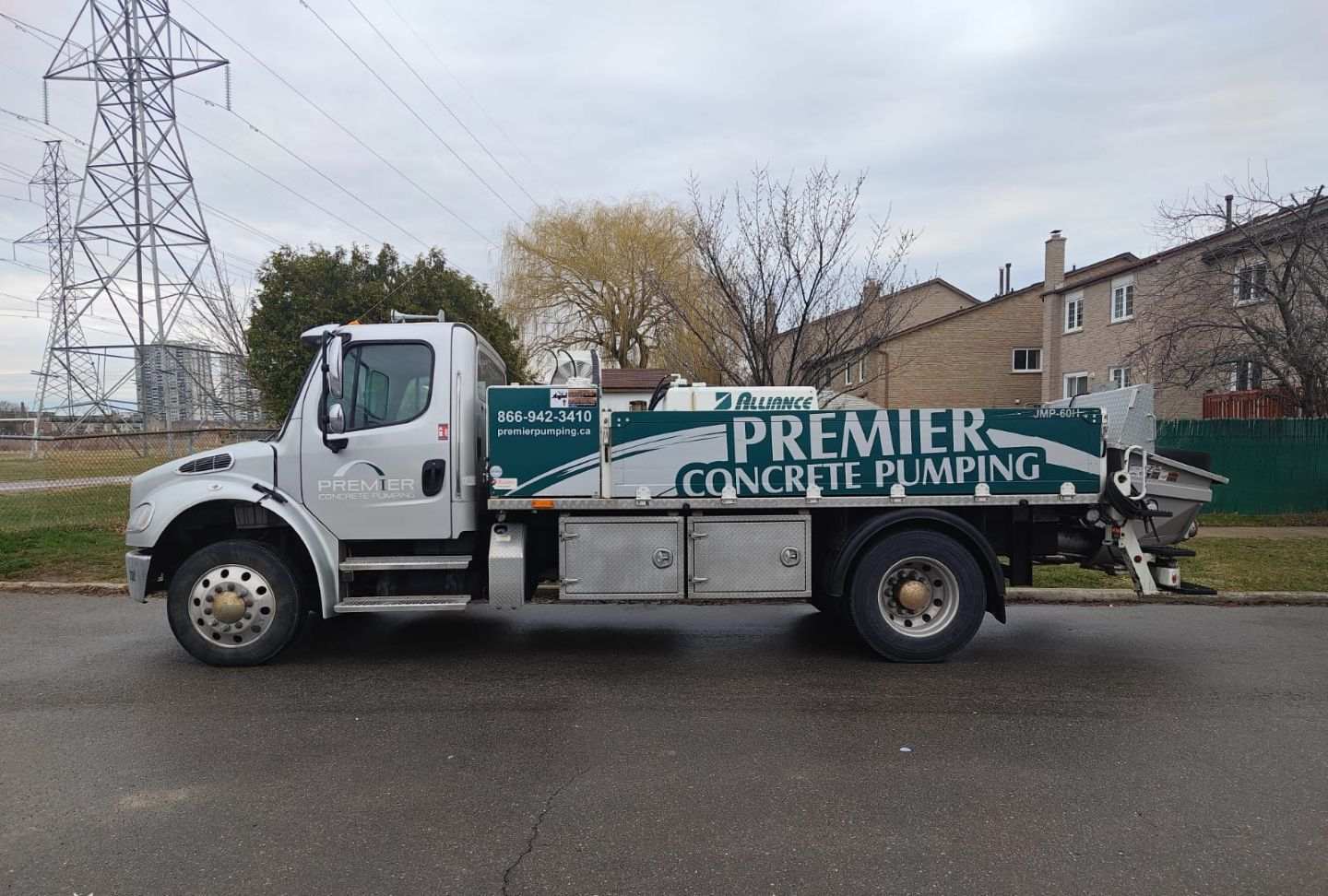
JMP-60 Line Pump
The same idea on a single truck, for sites with no room for a truck and trailer combination.

32m Alliance ZZ
The smallest boom in the fleet. Worth checking before you commit to laying line.

Telebelt TB 130
For stone, gravel and fill, which no pump can move, and for low clearance placement.
Check Availability for the Trailer Pump
Tell us where the concrete has to end up and how far that is from where a ready-mix truck can stand. That is the whole question on a line pump job. No obligation.