Basement concrete pumping is very different from open slab or foundation pours. Access is tighter, visibility is limited, and planning matters more. In this guide, we explain exactly how basement concrete pumping works, what to expect on pour day, and how to prepare confined basement spaces so the job runs safely and efficiently. Everything below is based on real basement pours we handle across Ontario.
When Basement Concrete Pumping Is Required
We typically pump concrete into basements for two main types of projects.
The first is new home construction, where we are placing concrete for basement slabs or foundation elements before the structure is built above.
The second is existing homes, where the basement has been excavated to increase ceiling height. These jobs are more complex. Access is tighter, and pumping often needs to be done through windows or narrow openings.
In both cases, the biggest challenges are access, lighting, and communication.
Why Basement Pours Are More Challenging Than Other Jobs
Basement pumping is not about height. It is about control.
Unlike exterior pours, basement jobs often involve:
Limited entry points
Low ceilings or crawl spaces
Poor natural lighting
Tight hose routing
Operators working outside while crews work inside
Because of this, basement pumping requires extra planning before the pump ever arrives.
Step 1: Planning Access Before the Pump Arrives
Access is the first thing we evaluate.
Before we arrive on site, you should already know:
How the hose will enter the basement
Whether access is through a window, stairwell, or garage entry
If there is a clear and safe route for the line
Whether excavated areas are stable and walkable
Many delays happen when access is assumed instead of confirmed. We have seen jobs where crews expected someone to maneuver a hose into a two-foot crawl space without planning for it. That slows the job and creates safety risks.
If your site involves unusual access or routing, reviewing our approach to concrete pump setup for complex sites can help you plan ahead.
Step 2: Choosing the Right Equipment for Basement Jobs
Almost all basement concrete pumping is done using a line pump.
Line pumps are ideal because:
We are pumping down, not up
The line can be routed along the ground
Flexible hose can be used to maneuver through windows and tight turns
Boom pumps are rarely practical for basement pours because access points are usually too small, and control is limited once inside.
If you are unsure which pump type makes sense for your job, our concrete pump trailer and line pump services page breaks this down in more detail.
Step 3: Hose Selection and Routing in Tight Spaces
For basement pours, hose flexibility matters more than anything else.
We often use:
Rubber or flexible hose sections
Shorter line segments for easier movement
Minimal steel pipe once inside the structure
This allows the crew to maneuver around corners, down through window openings, and into confined areas without fighting rigid pipe.
Good hose routing reduces strain on the line and keeps flow consistent.
Step 4: Lighting Is Not Optional in Basements
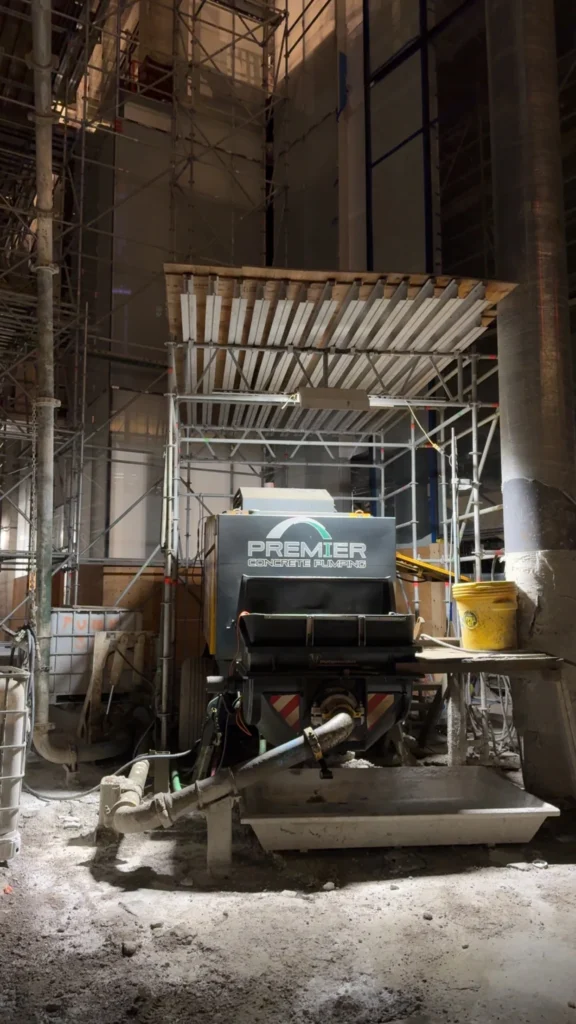
Lighting is one of the most common issues we see on basement pours.
Basements and underground spaces often have:
No installed lighting
Dark corners and crawl spaces
Poor visibility once concrete starts flowing
We have been on underground pours where crews had to work using flashlights because proper work lights were not set up. That slows placement and increases risk.
Before pour day, ensure:
Temporary work lights are installed
The entire placement area is visible
Shadows are minimized in corners and tight areas
Lighting directly affects safety, communication, and finish quality.
Step 5: Communication During Basement Concrete Pumping
On many basement jobs, our operator is not inside the basement.
That means communication must be clear and immediate.
We rely on:
Verbal signals when possible
Radios when visibility or distance is an issue
Clear stop signals agreed on before pumping starts
If anyone inside the basement sees an issue, the pump must be stopped immediately. That only works when communication is planned ahead of time.
This same safety-first approach is part of how we operate across all infrastructure concrete pumping and confined job sites.
Step 6: Managing Flow and Pressure in Confined Spaces
From a pumping standpoint, basement pours are not about higher pressure. They are about control.
There is nothing special required from the concrete mix beyond appropriate aggregate size. Mix design is usually determined by the ready-mix supplier.
During the pour, we focus on:
Consistent flow
Avoiding sudden surges
Watching hose movement closely
If the crew inside notices anything unusual, pumping stops, the line is inspected, and adjustments are made before continuing.
For more detail on how mix and line size affect performance, see choosing concrete mix and pump line size.
Common Mistakes We See on Basement Concrete Jobs
Most basement pumping issues come down to preparation, not equipment.
The most common problems are:
Poor access planning
Insufficient lighting
Unrealistic expectations of tight spaces
No clear communication plan
When these are addressed before pour day, basement pumping runs smoothly.
How Basement Pumping Fits Into Larger Projects
Basement pumping is often one phase of a larger project, whether it is a full foundation, ICF wall system, or residential build.
If your project involves insulated forms, you may also want to review:
For city builds with limited staging, our Toronto concrete pumping services page outlines how we plan around urban constraints.
Final Thoughts
Basement concrete pumping does not have to be complicated, but it does require planning.
When access, lighting, communication, and equipment are handled before pour day, confined basement pours can be just as smooth as any other job. Our goal is always to make the process predictable, controlled, and safe for everyone on site.
If you are planning a basement pour and want to walk through access or setup ahead of time, our team at Premier Concrete Pumping is always happy to help.