

38m 4-Section Concrete Boom Pump
- ACPA certified operator included
- WSIB clearance available
- Ontario owned since 1989
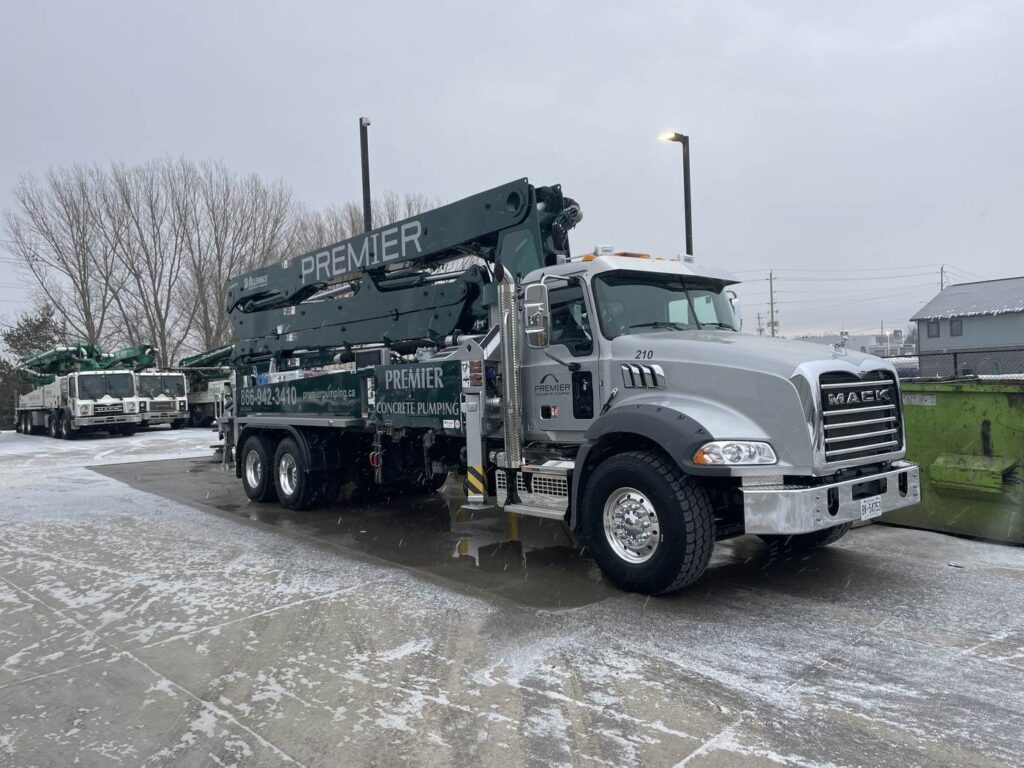
Four sections instead of five, which is the whole argument for this unit. Fewer joints mean fewer things to position, a quicker setup and a boom that behaves predictably on a straightforward pour. It reaches 37.1 metres up and 33.1 metres out, so it covers the mid-size work that makes up most of a busy season: house foundations, footings, garage and basement slabs, small commercial pads.
Other sizes in the fleet
Premier runs both a four section and a five section 38 metre boom, and the choice between them has nothing to do with reach. They land within half a metre of each other. It is about how the boom gets to the placement point.
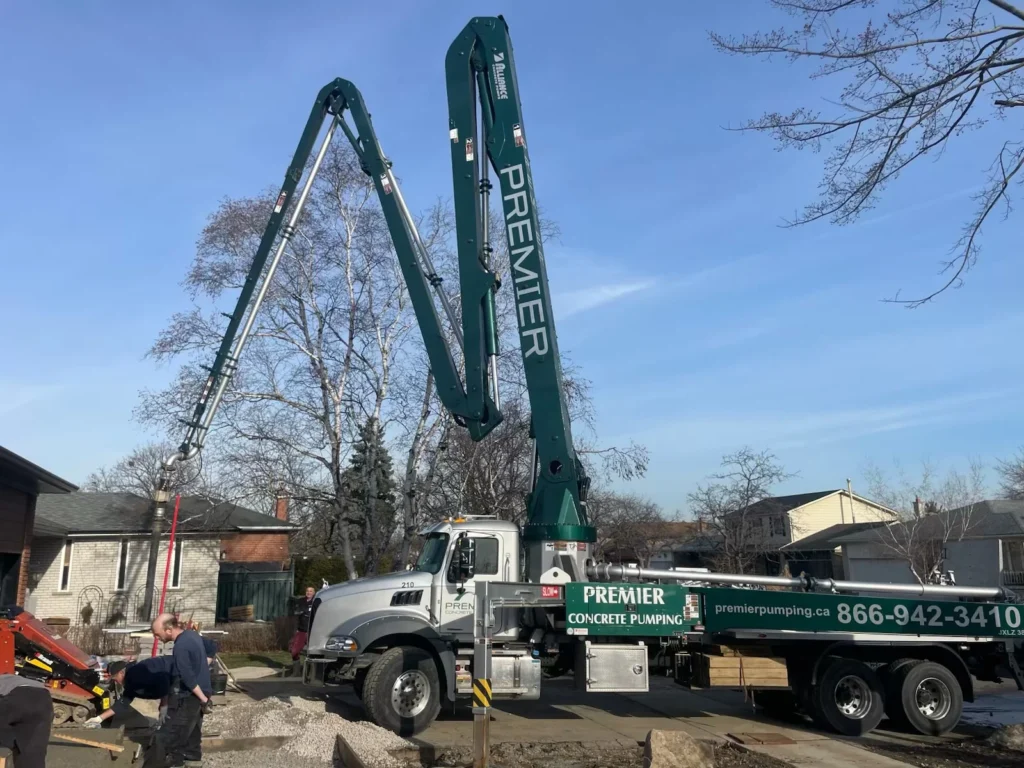
This is the four section. Its Z fold opens into a long, simple arc: sections of 7.85, 7.94, 8.33 and 12 metres, with the last one doing most of the work. On an open site that is exactly what you want. The boom goes up, swings over, and places. There is less to position, less to think about, and the operator is pouring sooner. Across a subdivision where the same setup repeats forty times, that adds up.
What it will not do is thread. If the concrete has to travel around a standing structure, under a soffit, or through a gap in the middle of the site, the extra joint on the five section earns its keep. Ask us which one is going out; we would rather send the right one than the available one.
Output is 164 m³/hr rod side, well beyond what a pour this size usually takes delivery of, so the ready-mix cycle sets the pace. Every booking includes an ACPA certified operator. Premier does not rent equipment without one.
Typical applications: residential foundations and footings, subdivision programs, basement and garage slabs, driveways and flatwork, ICF walls on open sites, small commercial pads.
Figures below are taken from the Alliance JXLZ 38-4.16 manufacturer specification sheet, not from summary listings elsewhere on the site. Model designation JXLZ 38-4.16.
📏 Reach and Boom
| Vertical reach | 37.1 m (121’9″) |
| Horizontal reach | 33.1 m (108’7″) |
| Unfolding height | 8.9 m (29’2″) |
| Boom sections | 4 |
| Fold type | Z fold |
| Pipe diameter | 125 mm (5″) |
⚙️ Output and Pressure
| Output, rod side | 164 m³/hr (215 yd³/hr) |
| Output, piston side | 102 m³/hr (133 yd³/hr) |
| Pressure, rod side | 72 bar (1,044 psi) |
| Pressure, piston side | 115 bar (1,668 psi) |
| Strokes per minute | 31 |
| Stroke length | 2,100 mm (83″) |
🔧 Pump and Hydraulics
| Concrete cylinder | 230 mm (9″), hard chromed |
| S-tube size | 9″ x 7″ |
| Hopper capacity | 600 L, easy clean |
| Hydraulic pressure | 350 bar (5,076 psi) |
| Water tank | 800 L (211 gal) |
| Main oil pump | Rexroth Hydromatic A11VLO260 |
🚛 Outriggers and Chassis
| Outrigger style | X-style |
| Front spread | 6.3 m (20’8″) |
| Rear spread | 7.0 m (23′) |
| Boom section lengths | 7.85 / 7.94 / 8.33 / 12.0 m |
| Overall length | 11.9 m to 12.9 m, chassis dependent |
| Total weight | 24,540 to 25,630 kg (54,100 to 56,500 lbs) |
Piston side pressure of 115 bar is a system rating and is not to be used through boom pipe. Alliance supplies this unit on three chassis, so length and axle weights vary; confirm the exact truck at booking if either is critical. Need the full manufacturer document for a submittal package? Download the Alliance spec sheet PDF.
- ACPA certified operator. Every Premier operator is trained and certified to American Concrete Pumping Association standards. The unit does not go out without one.
- WSIB clearance certificate. Available on request for ICI and institutional prequalification packages.
- Daily equipment inspection. Completed before the unit leaves the yard, documented, and available if your safety officer asks.
- Lines, hoses and clamps for the configuration agreed at booking, including 2″, 3″, 4″ and 5″ line options.
- Pre-pour site walkthrough on commercial and institutional jobs, so setup position, outrigger bearing and washout are settled before pour day rather than on it.
- Repeat-site scheduling. On subdivision and multi-lot programs Premier can hold the same unit and operator across the run, which is worth more than it sounds once a crew is used to working with them.
- Unionized labour standards and OHSA compliance, as required on most commercial ICI sites.
Fuel, washout facilities and site access are the contractor’s responsibility unless agreed otherwise in writing at booking.
A mid-size boom on a straightforward site, which is the easiest combination Premier deals with. These are still worth confirming before the truck is dispatched.
- Outrigger spread. 6.3 m across the front and 7.0 m at the rear. Note the rear is wider than the front on this unit, which catches people out who are used to the smaller pumps. Allow a clear area of roughly 7.5 m each way.
- Ground bearing. 24,540 to 25,630 kg depending on chassis, concentrated through four pads. Fresh backfill, buried services and septic beds all need review first. Cribbing or pads may be required.
- Overall length. 11.9 m to 12.9 m of truck before outriggers. Check gate widths, turning circles and the access route.
- Overhead clearance. The boom needs 8.9 m of unfolding height. On treed lots and older streets with overhead wiring this is the constraint that decides the setup position, and occasionally the unit. Premier will not set up under live lines.
- Washout. A washout location must be nominated before the pour. Premier does not wash out to grade or to drains.
- Rail corridors. Premier runs range limiting systems, so pours adjacent to rail are possible. Flag it at booking, it changes the setup.
If overhead clearance is the problem rather than reach, the 32m ZZ opens in 5.65 m. Our guide to prepping a site for concrete pumping covers the rest.
Is the 38m 4-section the Right Pump for Your Pour?
Specify this unit when
- House foundations, footings and basement slabs where the pour is straightforward and the setup position is obvious
- Subdivision work, where the same setup repeats lot after lot and minutes saved on each one add up
- Garage slabs, driveways, patios and flatwork within 33 metres of where the truck can stand
- Small commercial pads and light industrial slabs
- ICF walls on open sites, where lift-by-lift control matters more than boom articulation
Use a different unit when
- Pours needing the boom threaded around an obstruction. Four sections articulate less than five; the 38m 5-section is the same reach with more joints
- Congested sites with overhead wires or trees. Unfolding height is 8.9 m, so it needs real clearance to open. The 32m ZZ opens in 5.65 m
- Anything above roughly eleven storeys, or a carry longer than 33 metres. Look at the 43m or 50m
- Enclosed, basement or low-clearance work. Use the trailer and line pumps
- Stone, gravel or fill. That is a telebelt job
How It Compares to the Units Either Side
| Unit | Vertical | Horizontal | Best for |
|---|---|---|---|
| 32m Alliance ZZ | 31.4 m | 26.9 m | Tight access and low headroom, opens in 5.65 m |
| 38m 4-section Alliance (this unit) | 37.1 m | 33.1 m | Straightforward mid-size pours, quickest setup at this reach |
| 38m 5-section Putzmeister | 37.5 m | 32.8 m | Same reach, extra joint, congested sites |
| 43m Alliance RZ | 42.5 m | 38.5 m | When 33 m of carry is not enough |
The two 38 metre units are within half a metre of each other on reach, so the decision is about articulation and setup speed, not size. Tell us what is in the way between the truck and the pour and we will pick.
Where the 38m 4-Section Earns Its Place
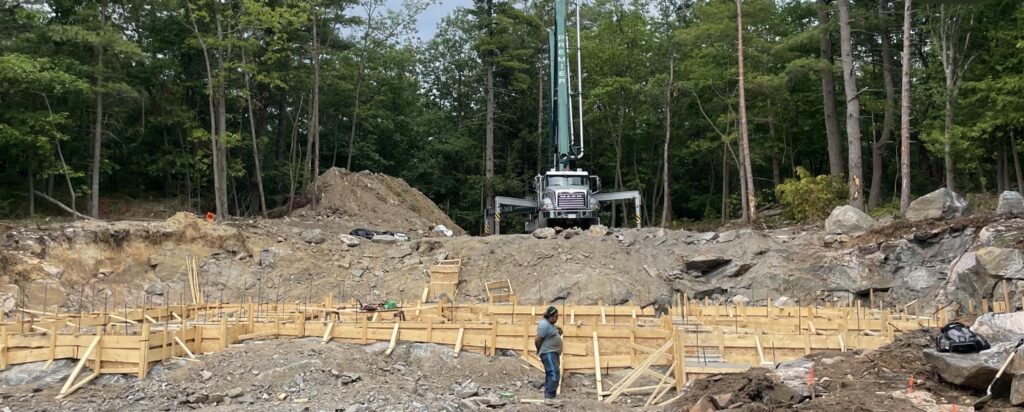
This is a workhorse rather than a specialist. It spends its season on residential foundations, subdivision footings, garage and basement slabs, and the small commercial pads that sit between a residential pour and a full ICI program. On sites like the rural foundation in the gallery above, the truck sets up once on firm ground, the boom goes up, and the pour runs without anyone negotiating the boom around anything.
That predictability is the point. On repeat work, a boom with fewer joints is quicker to place and quicker to pack up, and across a subdivision that difference is measured in pours per day rather than minutes. If your site is more awkward than that, read our guide to how far a boom pump can reach and which size to rent, or compare it against the 38m 5-section, which trades setup speed for articulation. For foundation work specifically, block versus poured foundations covers what changes about the pour.
Frequently Asked Questions, 38m 4-section
What is the difference between the 4-section and 5-section 38m?
Reach is effectively the same: 37.1 m vertical on this unit against 37.5 m on the five section. The difference is articulation. Four sections open into a simpler arc, which is faster to set up and easier to position on an open site. Five sections bend more, so the boom can be threaded around a structure or into a gap. Open site, take the four section. Anything in the way, take the five.
How high can the 38m 4-section actually pump?
37.1 metres vertically from ground level at the truck, and 33.1 metres horizontally from the boom pedestal. That covers roughly eleven storeys, or any standard residential and light commercial pour. The fleet listing rounds these figures up; the ones here come from the Alliance spec sheet.
How much space does it need to set up?
Allow roughly 7.5 metres of clear working area each way. Outrigger spread is 6.3 m at the front and 7.0 m at the rear, so unusually the rear is the wider end. The truck is 11.9 m to 12.9 m long before outriggers, depending on chassis. It also needs 8.9 m of overhead clearance to unfold.
Is an operator included in the rental?
Yes. Every Premier unit goes out with an ACPA certified operator. Premier does not rent pumps as equipment only. The operator coordinates with your forming crew and handles setup, placement and washout.
Can you hold the same unit across a subdivision program?
Usually, yes, and it is worth asking for. On multi-lot work Premier can schedule the same pump and operator across the run. Once an operator knows your forming crew and the site layout, setups get faster and there is less to explain each morning. Book the program rather than the individual pours.
What placement rate can I schedule against?
The pump is rated at 164 m³/hr rod side and 102 m³/hr piston side. On the work this unit suits, the ready-mix cycle is almost always the real limit rather than the pump. Give us your volume and access and we will give you a realistic figure to build the schedule on.
Popular Equipment
The units Ontario contractors book most often, alongside this one.
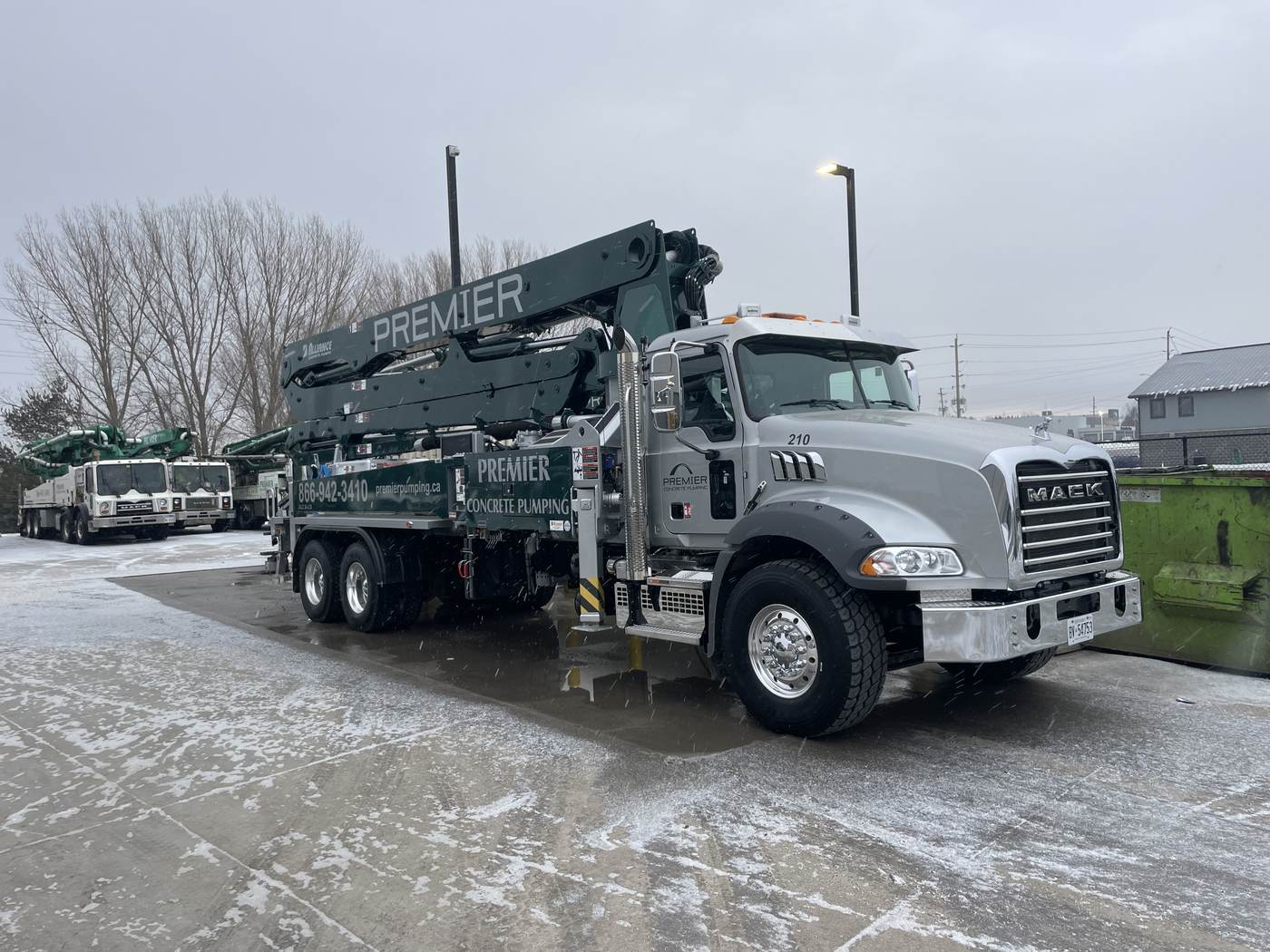
38m 5-Section
The same reach with an extra joint, for pours that need the boom threaded rather than simply raised.

32m Alliance ZZ
Half the outrigger footprint and a 5.65 m unfolding height, for sites this unit cannot get into.

Trailer and Line Pumps
For basements, indoor pours and sites with no boom access at all. Reaches through line instead of over the top.
Check Availability for the 38m 4-Section
Send the pour date, the volume and where the truck can stand. We will confirm whether this unit fits or point you at the one that does. No obligation.