
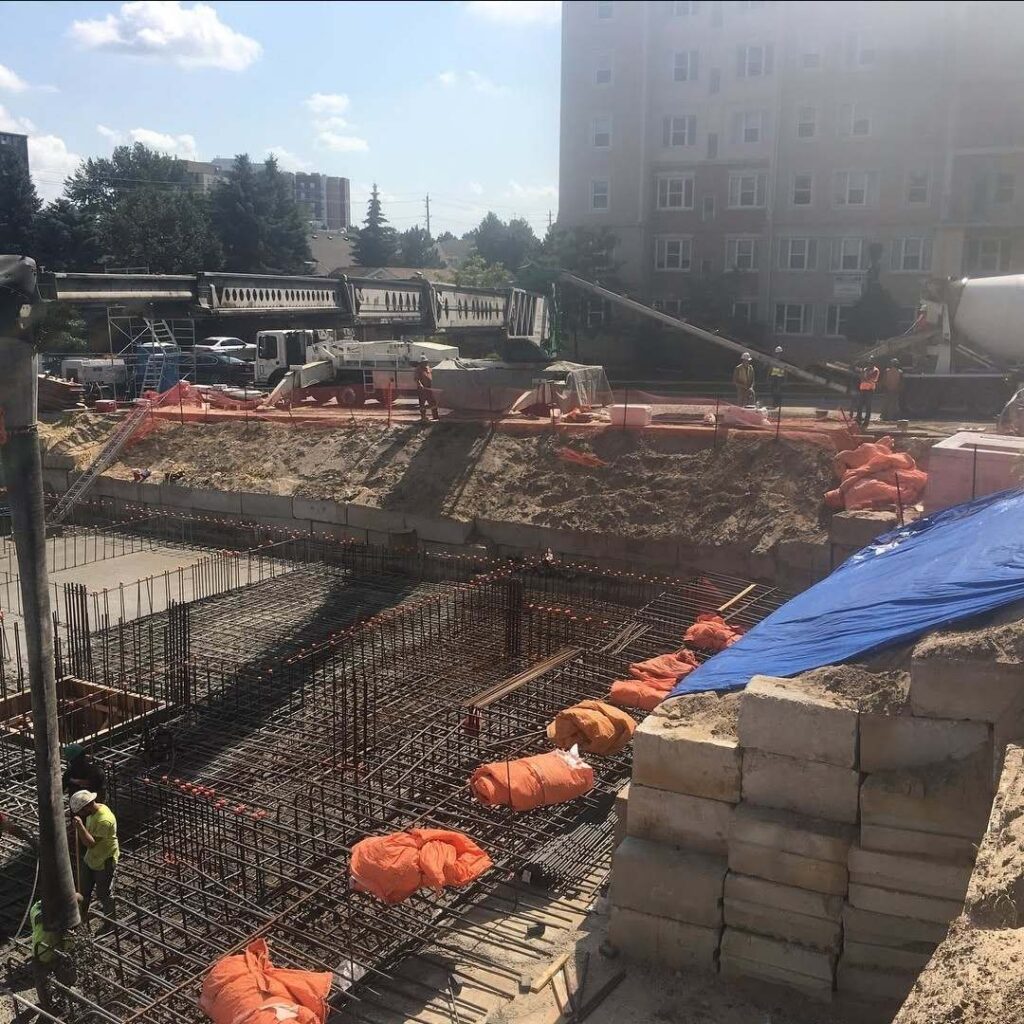

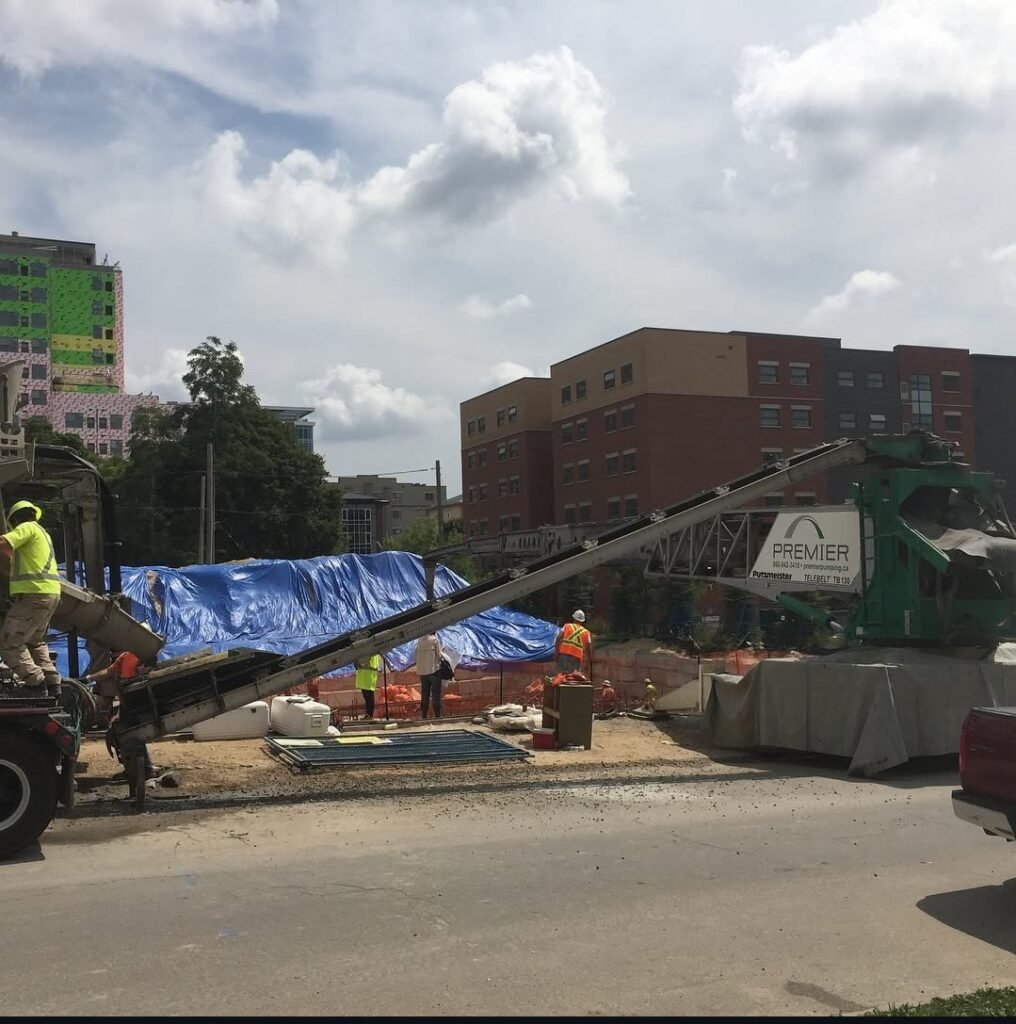
Telebelt TB 130 Conveyor
- Trained operator included
- WSIB clearance available
- One unit in the fleet, book early
A telebelt is not a pump. It is a five section telescopic conveyor belt that carries material out to 38.56 metres and drops it where you want it, with no pipeline to prime, no line to wash out and no mix restrictions. That makes it the answer for the material a concrete pump cannot handle at all: stone, gravel, sand, fill and aggregate, as well as concrete on jobs where priming and cleanout would cost more than the pour.
Other sizes in the fleet
Everything else in Premier’s fleet pushes material through a pipe. This carries it on a belt, and that one difference decides most of the jobs it goes to.
The TB 130 is a five section telescopic conveyor on a Mack chassis. It extends to 38.56 metres at horizontal, or 33.74 metres when angled up to its maximum 29 degrees, discharging 20.81 metres above grade at that angle. It also works downward, placing to 7.86 metres below the setup position. The belt is 457 mm wide and moves up to 275 m³/hr running flat, which is a genuinely high placement rate.
Because there is no pipeline, there is nothing to prime and nothing to wash out. There are also no mix restrictions worth speaking of: stone, gravel, sand, fill, aggregate and large-aggregate concrete all run on a belt, and none of them can be pumped. The other headline figure is 4.70 metres, the height it needs to set up. That is low enough for warehouse interiors, parkade decks and structures with the roof already on.
Premier runs one telebelt. It is the single most availability constrained unit in the fleet, so if your programme depends on it, book it early rather than close to the date. Every booking includes a trained operator.
Typical applications: stone, gravel, sand and fill placement, backfill behind retaining walls and around foundations, warehouse and parkade interiors, deep footings, trench work, and concrete placement where priming and cleanout would outlast the pour.
Figures below are taken from the Putzmeister Telebelt TB 130 manufacturer brochure, not from summary listings elsewhere on the site. Model designation TB 130. Reach and capacity both vary with the angle the belt is run at, so both figures are given.
📏 Reach and Conveyor
| Horizontal reach at 0 degrees | 38.56 m (126’6″) |
| Horizontal reach at 29 degrees | 33.74 m (110’9″) |
| Discharge height at 29 degrees | 20.81 m (68’3″) |
| Discharge depth at -15 degrees | -7.86 m (-25’10”) |
| Unfolding height | 4.70 m (15’4″) |
| Conveyor sections | 5, telescopic aluminium |
⚙️ Capacity and Belts
| Rated capacity at 0 degrees | 275 m³/hr (360 yd³/hr) |
| Rated capacity up to 20 degrees | 175 m³/hr (230 yd³/hr) |
| Main conveyor belt width | 457 mm (18″) |
| Feed conveyor length | 11.60 m (38′) |
| Feed conveyor belt width | 457 mm (18″) |
| Trunk and end hose length | 4.57 m (15′) |
🔧 Setup and Outriggers
| Net reach beyond outriggers, 0 degrees | 36.81 m (120’9″) |
| Net reach beyond outriggers, 29 degrees | 31.99 m (105′) |
| Outrigger spread, front | 8.46 m (27’9″) |
| Outrigger spread, rear | 8.84 m (29′) |
| Water tank capacity | 644 L (170 gal) |
| Hydraulic oil tank | 492 L (130 gal), with cooler |
🚛 Truck and Transport
| Conveyor weight | 10,124 kg (22,320 lbs) |
| Total transport weight | 34,612 kg (76,318 lbs) |
| Engine | 302 kW (405 hp) |
| Wheelbase | 7,925 mm (312″) |
| Cab height | 2,642 mm (104″) |
| Steering radius, outside | 13.87 m (45’6″) |
All figures are maximum theoretical values. Truck specifications and transport weights apply to the Mack MRU 613 the brochure specifies and vary with chassis and options. Need the full manufacturer document for a submittal package? Download the Putzmeister Telebelt brochure PDF.
- WSIB clearance certificate. Available on request for ICI and institutional prequalification packages.
- Daily equipment inspection. Completed before the unit leaves the yard, documented, and available if your safety officer asks.
- Lines, hoses and clamps for the configuration agreed at booking, including 2″, 3″, 4″ and 5″ line options.
- Trained conveyor operator. A telebelt is not run like a pump and Premier does not send it out without someone who knows it. Premier’s pump operators are ACPA certified; conveyor work is a separate skill and the unit goes out with someone who has it.
- Loading flexibility. The feed conveyor takes a ready-mix truck, a dump truck or a skid-steer, so the material source does not have to be decided before you book.
- Pre-pour site walkthrough. Worth taking up on every telebelt job. Belt placement depends on a clear line to the discharge point, which is easier to establish standing on the site than on a drawing.
- Unionized labour standards and OHSA compliance, as required on most commercial ICI sites.
Fuel, washout facilities and site access are the contractor’s responsibility unless agreed otherwise in writing at booking.
The telebelt has a large footprint and a heavy truck, but a very low setup height. That combination catches people out in both directions.
- Outrigger spread. 8.46 m across the front and 8.84 m at the rear, hydraulically extended out and down. Allow a clear area of roughly 9 m each way.
- Unfolding height. Only 4.70 m, which is the whole point of the unit. Warehouse interiors, parkade decks and roofed structures are all workable. Confirm the door or opening the truck comes through, not just the ceiling height inside.
- Ground bearing and transport weight. 34,612 kg total in transport. Interior slabs, basement decks and fresh fill all need review before the truck comes on, and on suspended slabs that review is not optional.
- Turning circle. Outside steering radius is 13.87 m. On interior and yard work this is often the real constraint rather than the setup footprint.
- Clear line to the placement point. A belt cannot bend around a structure the way a boom can. The discharge path has to be clear, which is what the walkthrough is for.
- Material feed position. The feed conveyor has to be reachable by whatever is loading it, so plan where the ready-mix or dump truck stands at the same time as where the telebelt does.
- Cleanup. The belts run clean and need only water, so there is no washout slurry to deal with. Water still has to come from somewhere on site.
If the site cannot take a truck this size, or there is no clear line to the placement point, the trailer and line pumps reach through hose instead.
Is the Telebelt TB 130 the Right Pump for Your Pour?
Specify this unit when
- Stone, gravel, sand, fill and aggregate placement, which no concrete pump can do at all
- Backfill behind retaining walls, around foundations and into trenches where a truck cannot back up
- Low clearance work. It sets up under 4.70 m, so warehouses, parkades and structures with a roof already on are in range
- Pours where priming and washing out a pipeline would take longer than the placement itself
- Difficult mixes and large aggregate that would be a blockage risk through line
- Placing below grade, with the belt working down to 7.86 m under the setup position
Use a different unit when
- Anything that needs height. Discharge tops out at 20.81 m, so a multi-storey pour is a boom pump job
- Tight sites. Outrigger spread is roughly 8.5 m each way and the truck is large. The 32m ZZ is the tight access unit
- Placement through an opening or around a structure. A belt needs a clear line; a boom does not
- Enclosed spaces with no line of sight to the placement point. Use the trailer and line pumps
- Any date you cannot commit to early. There is one telebelt and it books out
How It Compares to the Units Either Side
| Unit | Reach | Sets up in | Handles |
|---|---|---|---|
| Telebelt TB 130 (this unit) | 38.56 m out | 4.70 m | Concrete, stone, gravel, sand, fill, aggregate |
| BSA 1005 trailer pump | Through line | No boom | Concrete and grout only, but reaches enclosed spaces |
| 43m boom pump | 42.5 m up | 8.8 m | Concrete only, but places at height and around obstructions |
These three are not really competitors. The question is what you are placing and whether the placement point is up, along, or shut in. Tell us all three and the choice usually makes itself.
Where the Telebelt Earns Its Place
The telebelt gets booked for two quite different reasons. The first is material a pump cannot move. Stone, gravel, sand and fill go on a belt or they go in a wheelbarrow, and on a backfill job behind a retaining wall or around a foundation, the belt does in an hour what a crew would spend a day on.
The second is clearance. At 4.70 metres to set up, it deploys inside warehouses, under parkade decks and in structures that already have a roof on, where no boom pump can open. It also runs downward, placing to 7.86 metres below the setup position, which suits deep footings and basement backfill. Because there is no pipeline, there is nothing to prime before the first load and nothing to wash out after the last, which on a short placement is most of the time saved. If you are weighing a belt against a pump, our telebelt conveyor services page covers how Premier prices and schedules the unit, and pumping on remote and harsh job sites covers the access cases where it is often the only thing that works.
Frequently Asked Questions, Telebelt TB 130
What can a telebelt place that a concrete pump cannot?
Stone, gravel, sand, fill and aggregate, none of which can go through a concrete pump. It also handles large aggregate and stiff mixes that would be a blockage risk in line. If your job involves backfill or granular material as well as concrete, the telebelt does both in one visit.
How far does it reach?
38.56 metres horizontally with the belt flat, or 33.74 metres when angled up to its maximum 29 degrees, which puts the discharge 20.81 metres above grade. It also runs downward, placing to 7.86 metres below the setup position. Measured past the outriggers, net reach is 36.81 metres flat.
Can it work inside a building?
Often, yes. It sets up in 4.70 metres of height, so warehouse interiors, parkade decks and structures with the roof already on are all in range. The constraints are the opening the truck comes through, the turning circle, which is 13.87 metres outside, and whether the slab will take 34,612 kg. All three get checked on the walkthrough.
How fast can it place?
Up to 275 m³/hr with the belt flat, or 175 m³/hr angled up to 20 degrees. In practice the rate is set by how quickly you can feed it, since the belt takes material from a ready-mix truck, a dump truck or a skid-steer.
Do I need to prime or wash out a line?
No. There is no pipeline, so nothing to prime before the first load and no line to wash out after the last. The belts need only water to clean. On short placements that alone can be the reason to book a belt over a pump.
How far ahead should I book it?
As far as you can. Premier runs one telebelt, so unlike the boom pumps there is no second unit to fall back on. For a fixed pour date, or any programme that depends on the belt, book it well ahead rather than in the usual 24 to 48 hour window.
Popular Equipment
The units Ontario contractors book most often, alongside this one.

Trailer and Line Pumps
For enclosed spaces and long line runs where a belt has no clear path to the placement point.
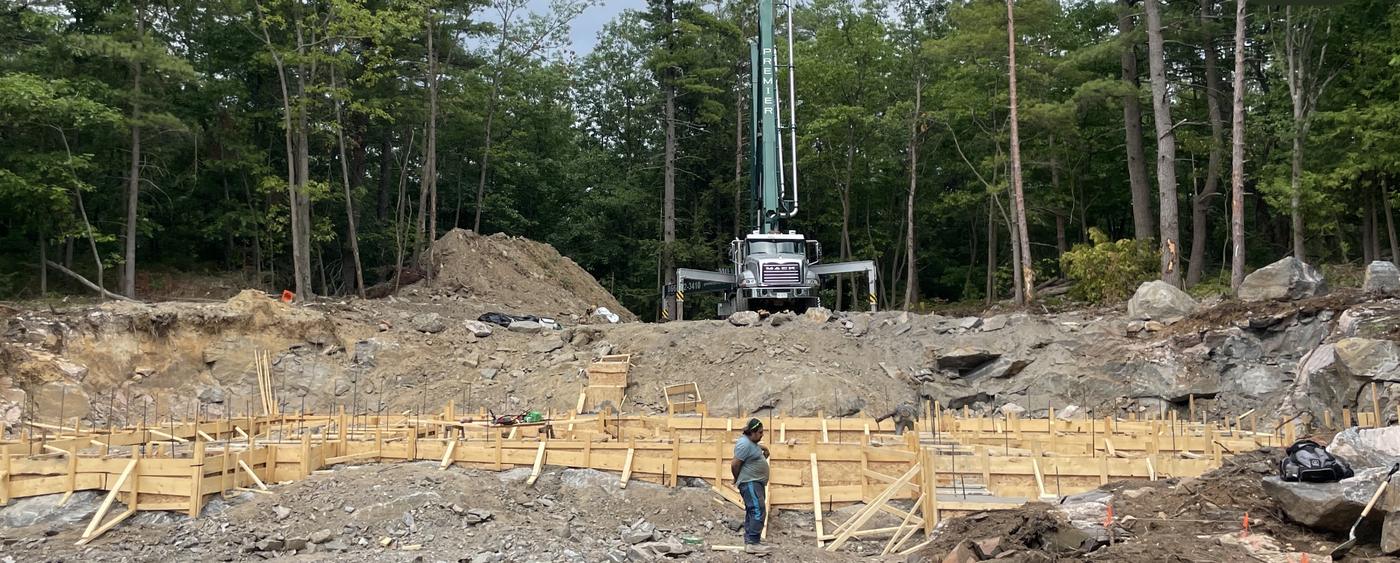
Boom Pumps
When the pour needs height rather than horizontal carry. 20m to 65m units, all with operators.
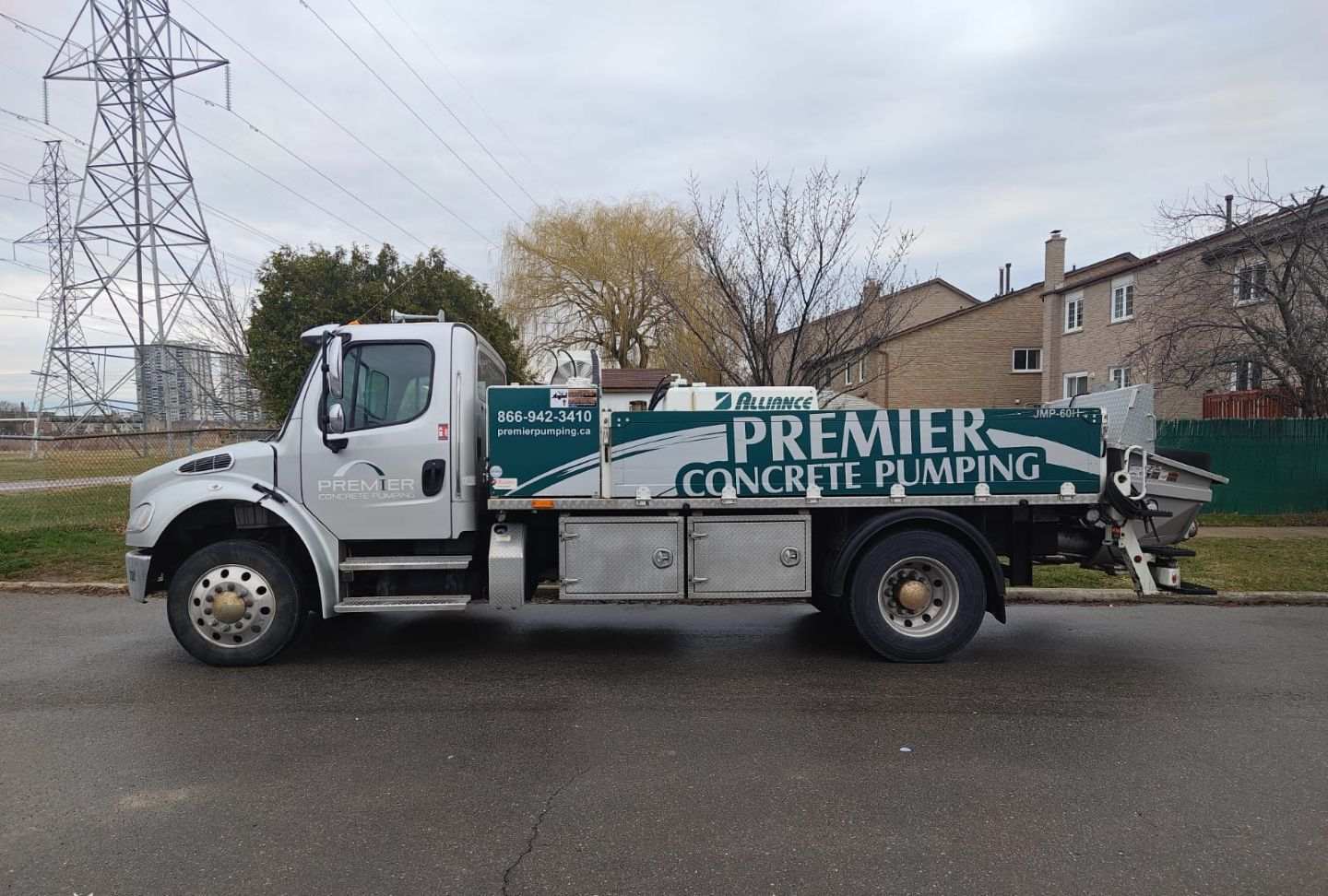
JMP-60 Line Pump
Truck mounted line pump for sites too small for a truck and trailer combination.
Check Availability for the Telebelt
There is one telebelt in the fleet and it books out, so give us as much notice as you can. Tell us the material, the volume and the distance and we will confirm. No obligation.