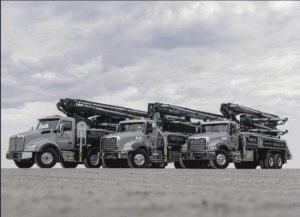
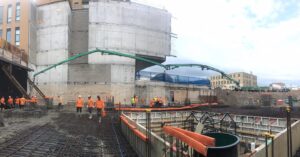
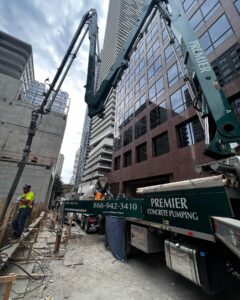
Pumping concrete near railways, inside tight urban areas, or around overhead hazards requires a mix of skill, technology, and strict safety controls. At Premier Concrete Pumping, we use advanced boom pump range limiting systems to ensure every pour stays safe, accurate, and compliant with Ontario’s infrastructure standards. This article explains how range limiting works, why it’s essential near train tracks and constrained sites, and how it improves efficiency, reduces risk, and protects your project from costly delays.
Why Railway & Tight-Site Concrete Pumping Requires Special Expertise
Every year, Ontario construction sites become more congested, more complex, and more safety-regulated. From active rail lines to downtown laneways, contractors rely on us because:
Boom reach must be controlled with precision
Railway corridors have strict “no-go” zones
Overhead wires, signals, and power lines limit movement
Tight residential spaces leave no margin for error
Traditional concrete pumping isn’t built for these environments. But our fleet is — equipped with systems that let us operate where most pumping contractors simply can’t.
If you’re working in these conditions, you may also want to explore our page on complex site setup:
👉 Concrete Pump Setup for Complex Sites
What Is a Range Limiting System?
A range limiting system is an advanced safety feature built into modern boom pumps that allows the operator to program the safe working envelope of the boom.
Think of it as a digital “fence” that the boom cannot cross.
The system uses:
Real-time sensors
Boom angle and position tracking
Programmable exclusion zones
Automatic slowdown and stop functions
Once a safe zone is defined, the pump physically prevents the boom from entering unsafe areas — even if the operator accidentally moves in that direction.
This technology protects against the biggest risks on tight job sites:
Overextending into traffic or rail corridors
Contact with overhead power lines
Hitting roofs, balconies, windows, or trees
Swinging into hydro poles, fences, or scaffolding
Why Range Limiting Is Essential for Concrete Pumping Near Rail Lines
Working beside an active rail corridor is one of the highest-risk setups in the pumping industry. Ontario rail operators enforce strict clearances that cannot be violated under any circumstance.
Range limiting systems allow Premier to work confidently and compliantly by:
✔️ Setting precise boundaries between the boom and the live railway line
Operators define a hard stop distance from tracks, catenary lines, signals, and service equipment.
✔️ Preventing accidental overreach
Even if the operator is distracted, the boom physically cannot swing into restricted railway zones.
✔️ Maintaining full regulatory compliance
Rail safety supervisors trust us because our systems actively enforce the limits required by permits.
✔️ Protecting the schedule
One accidental contact with a rail asset could shut down the track for hours — costing tens of thousands in fines and delays.
This is why major infrastructure contractors across Ontario rely on us for precast installs, rail bed work, pier fills, grout pours, retaining walls, and abutments.
Learn more about our infrastructure capabilities here:
👉 Infrastructure Concrete Pumping
Performing Concrete Pumping in Tight Residential & Urban Areas
Rail lines aren’t the only places where space is limited.
Downtown infill lots, laneways, backyards, subdivision homes, and tight-access properties all create major challenges:
Vehicles and pedestrians nearby
Houses close to property lines
Trees and landscaping
Garages and sheds
Balconies and decks
Power lines running overhead
Range limiting keeps the boom safely inside its intended work zone by:
✔️ Creating programmable exclusion zones
Operators can block out specific directions or angles — such as balconies, eaves, or neighboring roofs.
✔️ Triggering automatic slowdown as the boom approaches a soft limit
This gives operators higher control for sensitive pours.
✔️ Stopping movement entirely if a hard limit is reached
The system prevents any contact that may damage structures.
✔️ Using audible and visual warnings for added safety
The operator’s remote screen alerts them in real-time if the boom is nearing a boundary.
If your site has space constraints, you may also want to view our residential pumping page:
👉 Residential Concrete Pumping
Case Examples: Where Range Limiting Makes a Difference
1. Railway Bridge Restoration Work
For projects like the Gardiner Expressway restoration and other infrastructure pours, precast pieces are often set in sections. We then grout or fill the connecting joints. Range limiting ensures the boom stays within a narrow safe zone beside overhead signals and rail operations.
2. Precast Installations
When crews set precast piers or stairs, we fill the cores and spaces with precision. A small over-swing could hit the precast elements — range limiting prevents that.
3. Narrow Downtown Lanes
Some pours leave only inches of clearance between the boom and adjacent buildings. Range limiting creates a digital wall to keep the boom in a safe corridor.
4. Tight Backyard Projects
Homeowners love our ability to work where larger machines can’t even get close. With exclusion zones set, we pour slabs, walls, garage floors, and pools safely.
For related reading on slab pours, check out:
👉 Pouring a Concrete Floor Slab
Added Benefits of Range Limiting Systems on Every Job
Beyond safety, this technology brings additional advantages that save contractors time and money:
Improved Efficiency
Operators can work confidently near hazards without constant visual guesswork.
Reduced Incidents
Accidental contact with wires, siding, or structures is virtually eliminated.
Lower Insurance Risk
Safer sites mean fewer claims and smoother compliance.
Better Client Confidence
When a GC sees range limiting in action, they know the crew is operating at the highest professional standard.
How Premier Prepares for a Complex Job Site
Every railway or tight-access pour starts the same way — with planning.
1. Full Site Assessment
We evaluate:
Hazards
Clearances
Overhead obstructions
Work envelope
Truck position
Hose routing
2. Defining Safe Zones
Our operator programs limits on the remote:
Minimum distance from rail tracks
No-go arcs
Vertical height limits
Side-swing restrictions
3. Testing System Responses
Before the pour starts, we test slowdown and stop functions to ensure everything is working perfectly.
4. Controlled Pour Execution
With protection zones activated, the operator can focus fully on:
Flow rate
Hose control
Mix behavior
On-site crew coordination
If you want deeper guidance on professional pump setups, see:
👉 Choosing Concrete Mix & Line Size
Why Contractors Choose Premier for Railway & Tight Access Concrete Pumping
Largest range of boom options in Ontario
ICF specialists, commercial specialists, and infrastructure crews
Operators with decades of experience
Technology-equipped fleet: range limiting, load monitoring, sensors, and more
Ability to work confidently in high-risk areas
Fast response for complex jobs
Our operators are trained not just to run the machine — but to run it safely, efficiently, and with full awareness of high-risk environments.
FAQ: Concrete Pumping Near Railways & Tight Sites
Is pumping concrete near railways allowed?
Yes — with proper safety controls, permits, and technology like range limiting systems.
What type of pump is best near rail lines?
A boom pump with programmable range limits is ideal. Tight sites may also require a line pump depending on access.
👉 Line Pump & Trailer Pump Services
How close can a boom pump get to train tracks?
It depends on the permit, but range limiting systems allow millimeter-level control to maintain the clearance.
Do homeowners benefit from this technology too?
Absolutely — it protects roofs, windows, fences, landscaping, and nearby structures.
Final Thoughts: Safe, Smart, and Precise Pumping for Every Site
Whether your project is right next to an active rail line, inside a tight downtown alley, or squeezed between two houses, you need a pumping partner who can work safely in these specialized environments.
At Premier Concrete Pumping, our range limiting systems keep every pour:
✔ Safe
✔ Precise
✔ Controlled
✔ Compliant
✔ On schedule
You get peace of mind knowing the job will be done right — even where others can’t operate.