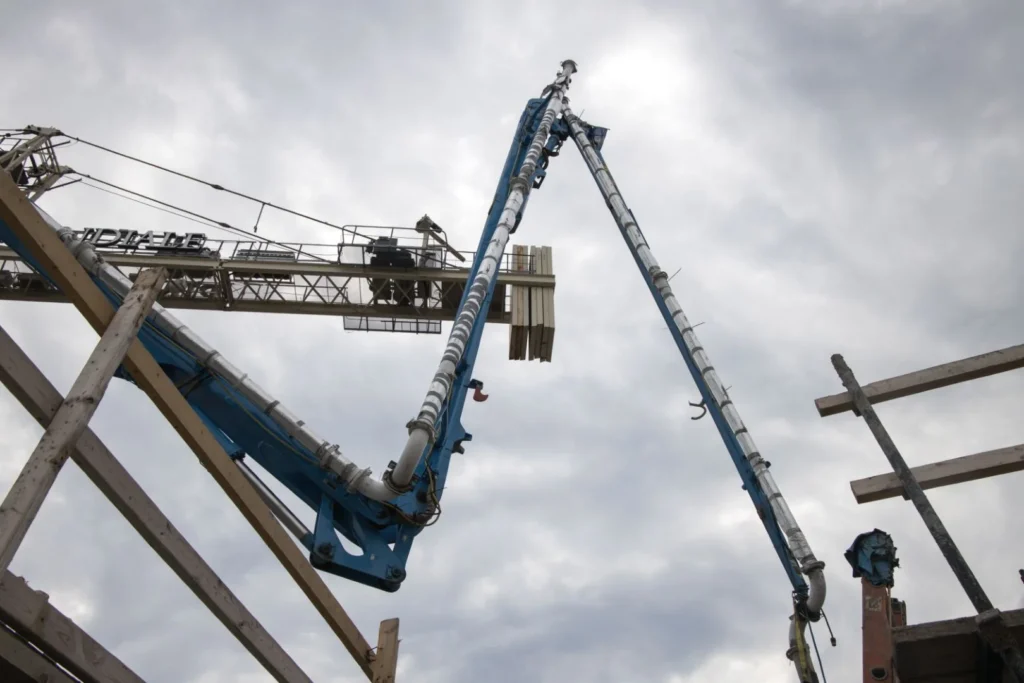
Once a condo tower or high-rise build climbs past the practical reach of a ground-mounted boom pump, the equipment on site has to change. That is where a placing boom comes in. It is a piece of equipment most GC project managers have seen towering over a downtown job site, but rarely get a full explanation of, and questions about setup timelines, jacking, mounting location, and removal come up on nearly every high-rise project we work.
We sat down with our own crew to walk through exactly how a placing boom works, from the day it first goes up to the day it comes back down, including what happens during jacking, how it gets fed concrete from the ground, what happens to the shaft it runs through once it is removed, and what it takes to keep one running safely 20 or more storeys in the air. This is a long, detailed breakdown, so use the table of contents below to jump to the section that matters most to your project.
Table of Contents
- What Is a Placing Boom?
- How a Placing Boom Differs From a Boom Pump Truck
- Why a Placing Boom Instead of a Boom Pump Truck
- How the Setup Works
- The Ground Pump That Feeds It
- Jacking: Moving the Boom Up as the Building Rises
- Where Does the Boom Get Mounted?
- Removing the Placing Boom
- Is There a Height Limit?
- What Happens to the Shaft After Removal?
- What Size Placing Boom Is Used for Condos?
- Can One Boom Service an Entire Building?
- Safety and Regulation During Jacking
- Wind and Weather Considerations
- Daily Inspections and Formal Engineering Checks
- Real-Time Flow and Placement Control
- Coordinating With Other Trades on Site
- What Happens If a Boom Has an Issue Mid-Pour?
- Long-Term and Winter Installs
- What GC Project Managers Should Build Into Their Schedule
- Frequently Asked Questions
What Is a Placing Boom?
A placing boom is a stationary concrete placement arm, essentially the boom off a truck-mounted pump, but mounted directly on the structure instead of a chassis. It does not drive, and it does not relocate on its own the way a boom truck does. Instead, it sits on a tower that is fixed to the building itself, and a concrete line runs internally through that tower, from a pump at ground level all the way up to the arm. The arm then places concrete on whatever floor it is currently working, whether that is 15 storeys up or 40.
Visually, it is closer to what you would picture on an old-style broadcast tower or a satellite mast than a piece of mobile equipment. The base is the tower, the arm sits on top of it, and everything needed to move concrete runs internally through that structure rather than externally along a hose laid across the ground.
How a Placing Boom Differs From a Boom Pump Truck
The core difference comes down to mobility and what feeds it. A boom pump truck is a self-contained, mobile unit. It drives to site, positions itself, and pumps concrete directly from its own hopper through its own boom, all from one chassis parked at ground level or on a lower floor slab. Once the pour is finished, it can drive to the next job.
A placing boom is the opposite of self-contained. It is permanently fixed in one location on the building for the duration of the project, it does not carry its own concrete source, and it needs a separate ground pump to feed it through an internal line. Where a boom truck’s reach is limited by how far its own arm extends from where the truck is parked, a placing boom’s reach is limited only by how high the tower it sits on can go, which in practice means as high as the building itself.
Why a Placing Boom Instead of a Boom Pump Truck
Placing booms come into play once a project reaches the practical limit of a ground-mounted boom pump truck. Every boom truck in a fleet, including Premier’s largest units, has a maximum vertical and horizontal reach. Once site conditions and building height push past what the largest boom truck can safely and effectively cover from the ground, or once the horizontal reach across upper floor plates becomes the limiting factor, a structure-mounted placing boom takes over.
It is important to understand that a placing boom is not brought in from day one. Early phases of a high-rise, including foundations and the first several storeys, are typically handled by boom trucks working from the ground or from lower floor slabs. The placing boom is introduced specifically for the phase of the project where reach from ground level is no longer sufficient, and it stays in place through to the top of the pour sequence.
How the Setup Works
Getting a placing boom fully operational is a multi-step process, and it does not happen in a single day. The boom itself and its base tower ship to site along with the ground pump that will feed it, while the concrete line is transported separately, since it arrives in individual sections rather than one continuous piece.
The ground pump is set in place at the base of the building first. From there, crews begin running the concrete line up through the structure, section by section, connecting each length of pipe as they climb. That part of the process is entirely manual. Operators, usually three at a time, physically work their way up the building, installing and securing each section of line as they go, floor by floor, until the full run reaches the arm at the top.
How long that takes depends heavily on how intricate the setup is and how high the building goes. On a straightforward run, initial installation of the line can take two to three days. On a taller or more complex structure, it can run longer. This lead time is one of the most important things for a GC to build into the schedule before the placing boom’s first working day, since the crew cannot pour a single yard of concrete through it until the full line is connected top to bottom.
The Ground Pump That Feeds It
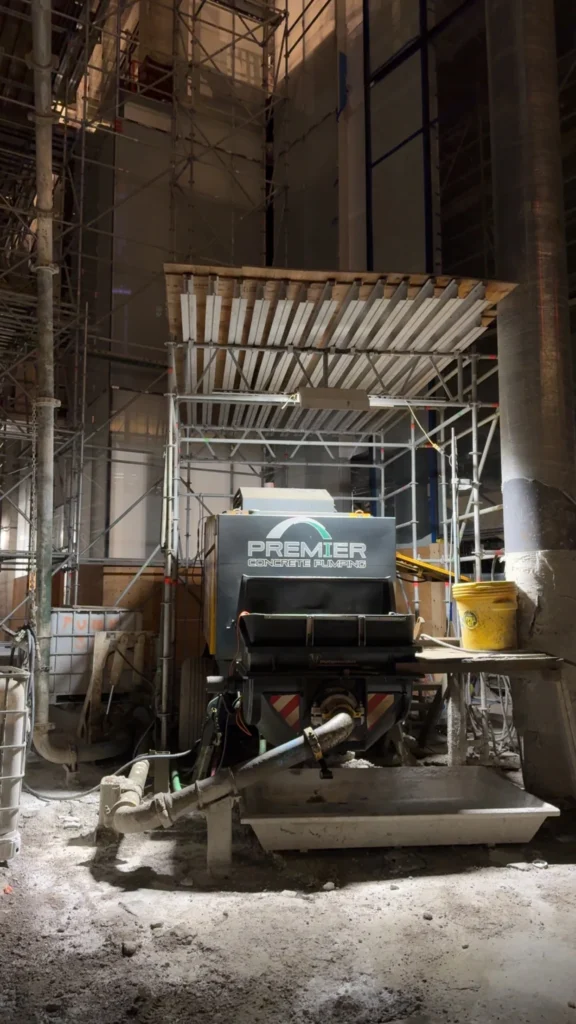
The pump feeding a placing boom is not a standard truck-mounted unit. It is a large stationary pump, roughly triple the size of a standard trailer pump, positioned at the base of the building for the life of the installation. Ready-mix concrete trucks pour directly into that pump at ground level, and the pump pushes the concrete up through the internal line in the tower to the boom’s arm, which then places it on the working floor.
Because this pump stays in one fixed location for the duration of the project, and because it is the single point that every yard of concrete going through the placing boom passes through, its reliability matters. It gets the same daily inspection attention as the rest of the system, and it is the first thing our shop manager checks if there is ever a slowdown or issue reported from the top of the boom.
Jacking: Moving the Boom Up as the Building Rises
A placing boom does not get relocated to a brand new position for every floor the way you might assume. Instead, once a floor is fully poured, the walls for that level are up, and the crew is ready to advance to the next storey, the entire assembly is jacked. Jacking means literally raising the tower, boom included, up one full storey so the arm is now working from the new floor level.
This is a physically involved process. The team essentially takes the whole setup, tower and all, and moves it up one story at a time as the building’s structure allows. Once everything is already installed and the crew is simply advancing the boom up a floor, a single jacking move typically takes about a day, sometimes a day and a half. It is a routine, recurring part of the schedule on any multi-storey pour and happens repeatedly, floor after floor, as the building climbs toward its final height.
Where Does the Boom Get Mounted?
Mounting location depends entirely on the layout of the specific building. Most commonly, the boom is run up through the elevator shaft, positioned close to the centre of the structure so the crew can effectively build outward from that central point as each floor comes together. This is the most common configuration on standard condo and high-rise towers.
On buildings where the elevator shaft is not a workable option, or where the floor plan calls for a different approach, the boom is instead mounted on the side of the structure, outside the building envelope. In that configuration, the arm places concrete by booming in over the edge of the building rather than reaching out from a central shaft. Which approach gets used comes down entirely to what the floor plan and site conditions allow, and it is a decision made in the planning stage before the boom ever ships to site.
Removing the Placing Boom
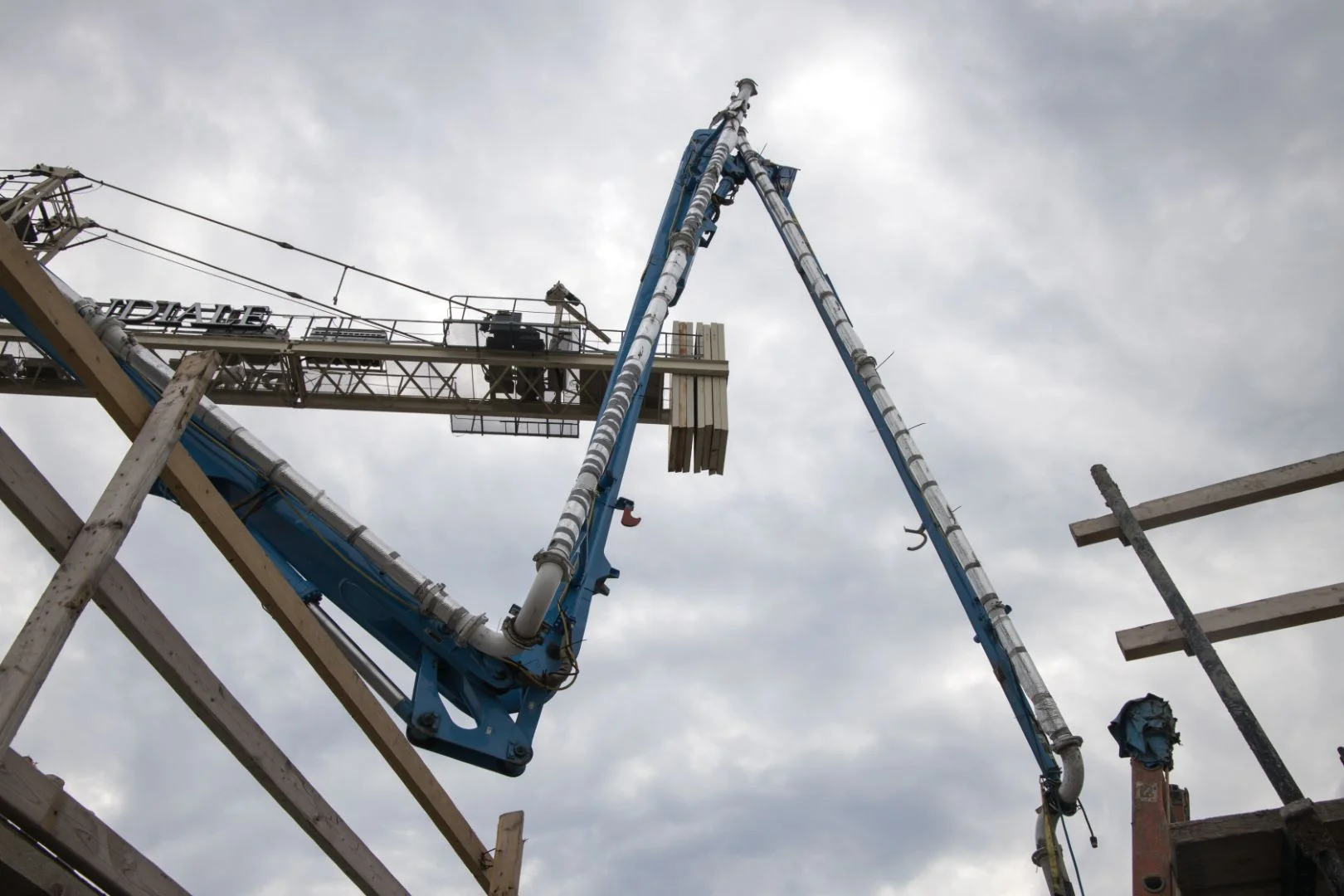
Removal is the setup process in reverse, and it is just as involved, if not more so. The same crew that installed the boom handles the dismantling. The arm itself is broken down at height, with a crane brought in specifically for this step. Once the arm has been dismantled by the crew, the crane lowers it to the ground onto the bed of a waiting truck, which then ships it back to the yard.
Once the arm is down, the crew moves on to removing the line, and this is where the process becomes lengthy. The line comes down floor by floor, in the same section-by-section manner it went up. The pipe itself comes in 10-foot lengths, so crews are physically taking down one 10-foot section, then the next, all the way from the top of the run down to the ground. Depending on how high the building went, this can take a meaningful stretch of time, and like the rest of the process, it is handled entirely by our own operators rather than a third party.
Is There a Height Limit?
There is no fixed maximum height for a placing boom. It goes as high as the building itself requires. In practical terms, the limiting factor on any given project is the structure being built, not the placing boom equipment. As long as the building keeps rising, the tower and boom keep getting jacked up to meet it.
What Happens to the Shaft After Removal?
Because most placing booms run up through the elevator shaft, removing the boom and every section of line leaves an opening at the top of that shaft once the equipment is gone. That opening does not stay open. It is typically capped with a cast-in-place piece of concrete, sized specifically to fit the shaft opening it needs to close.
Once the boom and every section of line have been fully removed, that concrete cap is lifted into position by crane, set precisely on top of the shaft opening, and sealed in place. This is a planned part of the demobilization sequence, not an afterthought, and it is coordinated with the GC’s schedule for finishing that part of the building.
What Size Placing Boom Is Used for Condos?
For a standard downtown condo or high-rise tower, a 36-metre or 38-metre placing boom is the typical choice, and the majority of the units in our fleet fall into that range. The difference in reach between the two sizes is small, roughly six feet, so the decision between them usually comes down to the specifics of the floor plate rather than a major functional gap.
A single boom in that size range is usually more than sufficient for a tall, narrow tower, since the building’s footprint is not especially wide even though it is climbing many storeys into the air. Reach across the floor plate, not height, is what determines whether one boom is enough.
Can One Boom Service an Entire Building?
Usually, yes. For a typical downtown high-rise, one placing boom is sufficient for the entire building, because the structure is tall but not especially wide, and a single boom positioned centrally can reach the full floor plate.
Wide buildings are a different story. On the South Niagara Hospital project, the structure was not particularly tall by high-rise standards, but it was extremely wide, and a single placing boom positioned in one spot could not reach across the entire footprint. That job called for four separate placing booms working across the site simultaneously rather than one. The number of booms a project needs comes down to the width and layout of the footprint, not the number of storeys. A GC planning a wide, low-rise institutional building, like a hospital or a large low-rise commercial structure, should expect this conversation to come up during planning, even if the building is nowhere near as tall as a downtown tower.
Safety and Regulation During Jacking
Once a placing boom is fully installed and running normally, day-to-day operation is straightforward. The highest-risk part of the entire process is jacking. That is the point where crews are physically up on a high-rise structure, 20 or more storeys in the air, disconnecting the boom and tower from its current position and moving the entire assembly up to the next floor.
Full working-at-heights compliance applies to every crew member involved in a jacking operation. That means confirmed working-at-heights certification, hard hats, full harnessing, and tie-off ropes for anyone working on or around the boom during a move. This is treated as the most demanding safety window in the entire lifecycle of the equipment, more so than routine day-to-day operation once everything is set and pouring normally.
Wind and Weather Considerations
Wind is a real factor in placing boom operations, given how high up the equipment sits. There is no single universal wind speed cutoff that automatically shuts the boom down. Instead, crews and site supervisors are expected to use direct judgment based on what they are seeing and feeling in real time. Everyone working near the boom is tied off regardless of conditions, but if the boom is visibly moving more than expected, or if conditions on site are clearly deteriorating, the call gets made on the ground to pause work until things settle. This is a site-level decision made collectively by the crew rather than a fixed technical threshold applied automatically.
Daily Inspections and Formal Engineering Checks
Every placing boom gets a daily inspection before it starts work for the day, conceptually similar to a driver’s circle check on a boom truck, though not identical since a placing boom is not a vehicle. Crews go through the valves, gauges, and clamps on the equipment, confirming that nothing is loose, nothing looks structurally compromised, and everything is sound before the system is turned on.
Beyond those daily checks, every placing boom in the fleet also goes through a formal inspection every four months, along with a full annual inspection carried out by a licensed engineer. This layered inspection schedule, daily visual and mechanical checks combined with periodic formal engineering review, is what keeps a piece of equipment running safely at height for the full duration of a multi-month or multi-year project.
Real-Time Flow and Placement Control
The placing boom operator controls the arm using a remote, functionally similar to how a boom truck operator would control theirs. The operator can maneuver the arm like a robotic extension, adjusting placement left, right, or further out as the pour requires. That control happens in constant, direct communication with the crew physically on the floor, making sure concrete is landing exactly where it is needed as the pour progresses across the slab.
Coordinating With Other Trades on Site
Sequencing the placing boom crew against forming, rebar, and finishing trades is handled by the general contractor, specifically the site superintendent. They are the ones managing which crew is scheduled on site on a given day, whether that means forming and rebar crews getting a wall or floor ready to pour, or our pumping crew coming in once the floor is confirmed ready. Our team does not manage that cross-trade scheduling. We show up ready to pour once the site confirms the sequence is in place and the floor is prepared, and the GC’s superintendent is the one coordinating everyone else around that pour window.
What Happens If a Boom Has an Issue Mid-Pour?
A placing boom is still a mechanical piece of equipment, and passing a morning inspection is not a guarantee against something going wrong later in the day. It is not common, but it can happen, whether that means something popping, blowing, breaking, or simply stopping mid-pour.
If an issue does come up during a pour, our shop manager is dispatched directly to site to diagnose it. He is our dedicated pump expert, and in most cases the issue turns out to be something straightforward that he can fix on site without needing to send the equipment back to the yard. Having that expertise on call is what keeps downtime to a minimum and gets the pour back up and running the same day in the majority of cases.
Long-Term and Winter Installs
On large, extended projects, a placing boom installation is not treated as a short-term rental that gets demobilized between phases. On the 215 Lakeshore East project in Toronto, the pump stayed on site and continued running through the entire winter rather than being pulled off site for the cold months.
Once a placing boom is installed on a project running a full year or two years, it stays in place for the full duration. It is not removed and reinstalled between seasons or phases. The crew simply pumps on the days that conditions allow, working around weather rather than demobilizing and remobilizing the entire system repeatedly. For a GC planning a long-duration high-rise build, this is worth knowing early, since it affects how site logistics and staging around the boom’s footprint need to be planned for the life of the project, not just a single season.
What GC Project Managers Should Build Into Their Schedule
If a placing boom is going on your next high-rise or condo project, there are a few realities worth building into your schedule from the start rather than discovering them mid-project:
- Initial setup takes real time. Running the line from the ground pump to the arm for the first time can take two to three days depending on building height and complexity, and no concrete moves through the system until that run is complete.
- Jacking happens repeatedly. Every time the boom advances a floor, expect roughly a day to a day and a half added to that portion of the schedule, and this repeats for the life of the project as the building climbs.
- Removal takes time proportional to height. Dismantling the arm and removing the line floor by floor, in 10-foot sections, is not a one-day job on a tall building.
- Wide buildings may need more than one boom. If your project has a wide, low footprint rather than a tall, narrow one, plan for the possibility of multiple placing booms rather than assuming one will cover the site.
- Cross-trade sequencing is on your team. Your site superintendent coordinates forming, rebar, and finishing crews around the pour schedule. Our crew pours once the floor is confirmed ready.
Building these realities into your schedule up front avoids surprises once the boom is on site and the pour sequence is underway.
Premier Pumping’s placing boom services are backed by 35-plus years of experience on ICI and commercial high-rise projects across Southern Ontario, including landmark builds like CIBC Square in downtown Toronto. All operators are unionized, WSIB-covered, and ACPA certified, and full safety documentation is available for any commercial or institutional prequalification package.
Frequently Asked Questions
How high can a placing boom reach?
There is no fixed maximum height. A placing boom goes as high as the building requires, since the tower it sits on is jacked up one storey at a time as construction progresses. The building itself, not the equipment, is the limiting factor.
How long does it take to set up a placing boom on a high-rise?
Running the concrete line from the ground pump up to the arm for the first time typically takes two to three days, depending on how high the building is and how intricate the setup is. No concrete can be pumped through the system until this initial run is fully connected.
What is jacking, and how often does it happen?
Jacking is the process of raising the entire placing boom tower up one storey once a floor is complete and the crew is ready to advance. It happens repeatedly throughout the project, once per floor advance, and typically takes about a day to a day and a half each time.
Where does a placing boom get mounted on a building?
Most commonly through the elevator shaft, positioned near the centre of the structure. On buildings where that is not workable, the boom is mounted on the side of the structure instead, placing concrete by booming in over the edge of the building.
Does one placing boom cover an entire building?
For a typical tall, narrow condo or high-rise tower, yes, one boom is usually sufficient. For wide, lower-rise buildings, such as a hospital or a large institutional structure, multiple placing booms may be needed to reach across the full footprint.
What happens to the elevator shaft after the placing boom is removed?
Once the boom and all sections of line are removed, the opening at the top of the shaft is capped with a cast-in-place piece of concrete, sized to the shaft, lifted into position by crane and sealed in place.
Are placing booms removed in the winter?
Not on long-duration projects. On multi-month or multi-year builds, the placing boom and its ground pump typically stay on site through the winter, pumping on the days weather allows rather than being demobilized and remobilized between seasons.
What size placing boom is used on a typical condo project?
A 36-metre or 38-metre placing boom is standard for most downtown condo and high-rise towers, with only a small difference in reach, about six feet, between the two sizes.
If you have an upcoming condo or high-rise project that will need a placing boom, contact Premier Pumping to talk through your building layout, phase schedule, and timeline.